Wednesday, September 21, 2016

Germany - Berlin and Potsdam

We’ve managed to jettison a few items along the way so far, and packing is getting easier.  We had another EasyJet flight ahead of us to get to Berlin, but their packing restrictions were not as much a burden this time; we didn’t have to resort to much devious activity to circumvent them.  After this flight, we won’t be traveling by air again for another month, and we’re thankful to be away from airports for a while. The security process was a breeze this time, and by some miracle, I didn’t set off any alarms as I walked through the metal detector.  I almost felt cheated without receiving my usual x-ray and frisking.

After an uneventful hour-long flight, we touched down in Germany and began the process of traveling to Potsdam, a city located about thirty minutes outside of Berlin and site of the Potsdam conference of 1945.  It’s also the former headquarters of the KGB in East Germany during the Cold War.  We had a long, quiet taxi ride with a driver who spoke no English and wasn’t interested in pointing out the sights—a good thing, because there weren't any.  The land was flat, brown, and mostly empty with a few copses of trees here and there breaking up the long expanses of fields.  At interchanges there were a few squat, graffiti-covered buildings that looked like abandoned sentry posts, and my vision of a castle-covered, Bavarian forest slowly evaporated as we motored along deeper into the country.  I had an infusion of hope at one point as two plump, colorful pheasants burst from a field, plopped down in the middle of the road, and skittered around a moment before taking flight again.  My medieval dreams had new life again thanks to two wayward game birds, but my reverie wouldn't last long in this area of Germany.

We arrived in Potsdam and pulled up to our flat, and unlike previous experiences, gained quick entry.  While the exterior of the apartment building wasn’t very attractive, the interior of the flat was bright and cheerful with crisp white walls and honey-toned wood floors.  It was also spacious with a large kitchen and dining area and a living area which also doubles as the bedroom.  The bathroom was recently renovated, and all of the fixtures are shiny chrome.  We’re pleased with our own headquarters for our four-day stay in Potsdam, East Germany.  

Deena and I walked to the grocery store on the corner while the kids got settled in, and we felt we had found the land of milk and honey at the REWE market.  This store was fabulous, and we spent an hour translating German and finding bargains.  Did you know the German word for olive is “olive”?  Similarly, the German word for ham and turkey breast is “schinken und putenbrust.”  French, Spanish, and Dutch to some extent are languages with similar roots to English, and one can get by where they are dominant by inference and a bit of common sense.  German ain’t that way.  It’s a real jaw cracker of a language, and we’re hoping for the kindness and pity of strangers to get us through the next few days.  We managed to buy several days worth of food for minimal euros, and we walked triumphantly back to the flat and cooked bratwurst and potato pancakes for supper to celebrate.  Did you know the German word for bratwurst is “bratwurst”?  Similarly, the German word for potato pancake is “kartoffelpfannkuchen”.  And now, we have to figure out the public transportation system here, Lord help us.

Next day I got up early to do some writing while the rest of the family slept off the travel hangover.  There’s a coffee maker here, and I made a big pot of strong brew from a bin of aromatic grounds provided by our host.  I sat at the kitchen table to write and looked out on the grounds of the apartment blocks as the sun’s rays crept up the sides of the buildings.  After the rest of the family rolled out of bed, we had a big breakfast of scrambled eggs, toast and jam, and fruit with yogurt.  We chopped up the leftover bratwurst and mixed it with the eggs—sehr gut!  We had hoped to go into Berlin to church today, but we haven't figured out the buses yet,  and another taxi ride was cost prohibitive; so we sat on the sofa together and watched last week’s sermon from Pastor Alex back home.  Since we didn't get much schoolwork done in Amsterdam, so we decided to make this day one for studies and rest, and it was a good call as we all needed to recharge.  But by 4:00, we needed to get out of the flat for a while, so we took a walk around the neighborhood and wound up at McDonalds and, of course, ice cream consumption ensued.  I don’t think we gave ice cream enough consideration when we were in the budget stages of the trip, but with careful planning, it can become a permanent line on the ledger.  We have a walking tour scheduled in the center of Berlin tomorrow, so we’re heading to bed early tonight in the hope that sleeping on the computer logged into Google translate will result in German fluency in the morning.  

The leading authority for speakers and writers on all words containing letters of the alphabet, Webster’s Dictionary, gives the simple definition of communism as:  “a way of organizing a society in which the government owns the things that are used to make and transport products (such as land, oil, factories, ships, etc.) and there is no privately-owned property.”    The slightly more complex definition adds:  “which results in a society of people living in fear of the government while suffering cold, hunger, and exploitation while leaders erect statutes and commission paintings glorifying the success of the state and its heroes, and everyone sits around in ugly buildings and drinks cheap vodka wondering what went wrong.”  Or something like that.

When Deena and I were planning this trip, Germany stumped us for a while.  There are many places to visit where one can soak up traditional German culture and marvel at the beauty of the Rhine, the Black Forest, and soaring medieval castles.  We ended up choosing Berlin, a city tarnished by a cruel dictator, leveled by war, and rebuilt during the uncertain period of the Cold War between the United States and the Soviet Union.  Woo hoo!  Let’s pack up the RV and go!  Part of our decision was based on proximity to our next destination, the Czech Republic, and travel logistics, but the rest was based on our desire to teach the children about communism, a form of government that Deena and I grew up fearing and one that Joseph and Deveny have only read about in books.  World history and American history converge in a unique way here, and we knew we could give our homeschool curriculum a serious boost in Berlin.  We were also curious to check out the vibe of the city and its recovery after many decades of torment and uncertainty.

We prepared for our big day in Berlin by loading up on a hearty breakfast, and after much research, we faced our fears and boarded the 693 bus bound for the S Bahn station and a train that would hopefully take us to the city center.  With no tickets in hand, we had to conquer the machine on the bus and its many options for public-transport passes in under five minutes before we arrived at the train station—no pressure.  We somehow pulled it off and jumped off the bus bearing four ABC passes that allowed one-day unlimited travel around Berlin by means of bus, train, or tram, and the whole bundle cost only 28 euros, roughly a quarter the cost of one taxi ride into the city.  We managed to board the correct train, and forty-five minutes later, we stepped onto the platform in the Alexanderplatz train station and began our day in Berlin.

Here’s a quick Cold War primer:  After WWII, the victorious allies sat down in Potsdam and divvied up the what was left of Germany.  The Soviets under Josef Stalin took East Germany; West Germany went to Britain, France, and the United States.  The initial intent was administration of postwar activities in those sectors, but things got out of hand.  Control of Berlin was split the same way with West Berlin becoming an island surrounded by all of East Germany.  I never understood this division completely in school, and I grew up thinking that East Germany and West Germany were divided by the Berlin Wall running smack through the middle of everything.  With the communist government cracking down on citizens fleeing to the capitalist west, The Berlin Wall went up quickly in 1961 surrounding the circle of West Berlin.  It separated families and ruined lives on both sides of the wall.  The next thirty years would bring the escalation of the Cold War with espionage, tension, and the threat of nuclear war between the USSR and the United States.  

Deena had signed up for a walking tour that she found online which included the major sights in the central area of the city.  Billed as a two-and-a-half hour excursion, the tour turned out to be an amazing four-hour odyssey into the architectural, social, and political heart of the city, and it covered every aspect of Berlin we were hoping for.  The weather was perfect for walking with sunny skies, temperatures in the mid-sixties, and a light breeze.  We were led by Ben, a thirty-something Australian chap with family ties to Germany, who had a gift for succinctly delivering historical facts through the use of humor and clever background stories.  

The majority of the tour took place in what was considered East Berlin up until 1990, with a brief walk into the western sector.  We started with a visit to the TV tower commissioned by the government of East Berlin to demonstrate the might of the German Democratic Republic, and it’s still the tallest structure in Germany.  From there, we spent all afternoon walking from Checkpoint Charlie to the Brandenburg Gate with many stops in-between, including the site of the famous Nazi book burning at Humboldt University, the Luftwaffe headquarters, a section of the Berlin Wall, the site of Hitler’s bunker, the Reichstag, the Memorial to the Murdered Jews of Europe, and many, many more.  Ben went into great detail about each stop and made sure we understood the political background involved and how it still affects the German culture today.  

On the side of the Finance Ministry building, the former Luftwaffe headquarters, there is a famous 18 meter long mural by Max Lingner painted on individual tiles from 1950 - 52, and it is classic communist propaganda.  Almost every character portrayed has the fake “I love communism” smile, and everyone is shown playing a joyful part in a successful society.  What a creepy reminder of the communist government in East Germany—it was my favorite part of the tour and Deveny’s as well.  Joseph enjoyed seeing the section of the Berlin Wall, and Deena thought the site of Hitler’s bunker was interesting.  The city government has spent a lot of money on historical signage and replicas in the area around Checkpoint Charlie.  For a couple of euros, one can be photographed in front of the guard shack with two actors in uniform—one tourist had the actors point a banana at him in place of a gun.  Considering all the death and despair associated with this area, I found it to be a bit distasteful, but that’s my problem.

Near the end of the tour, Ben had us sit and gather ‘round at the Memorial to the Murdered Jews of Europe where he told us about how the citizens of Germany and the city of Berlin are still very sensitive about the atrocities carried out in WWII.  One can face up to three years in prison for wearing a swastika or any other Nazi insignia, and there are no memorials of any kind to the German army or leadership from the 20th century.  He also talked about major companies still in existence today that are dealing with conflict for being associated with the Nazi government.  IBM has been linked to the information systems used in the concentration camps, and Hugo Boss designed the uniforms for the SS and other branches of the Nazi military.  From time to time, the large blocks at the Jewish Memorial where we were sitting get defaced by graffiti, and the paint is removed by a chemical that turns out is manufactured by the same company that produced some of the gas used in the concentration camps—unbelievable.

What an incredible day in Berlin—I’m glad our children could experience these things and understand a dark part of history in the not-too-distant past that have affected the people here and in the US.  The scars from those times are still visible in Berlin, but the citizens here are making the best of the reunification of East and West Germany.  We had a lot to talk about over another dinner of bratwurst (the kids’ request), and we ended the day by watching Bridge of Spies, an excellent movie directed by Steven Spielberg and starring Tom Hanks.  The movie portrays the events surrounding a prisoner exchange against the backdrop of Cold War era Berlin, and it all made sense to the children after our day in the city.

Checkpoint Charlie

Financial Ministry Building
Formerly the Luftwaffe Headquarters
Looks creepy, right?

Propaganda Mural

Memorial to the Murdered Jews of Europe

Brandenburg Gate

Communist Walking Man Crossing Light
Leftover from East Berlin, the citizens wanted
the man to stay.

A Remnant of the Berlin Wall

Portable Hotdog Stand
If he had an actual cart, he would have to buy a permit
Sticking it to the man German style, I love it!

We slept a little later the following day, and the children spent the morning on schoolwork, while Deena and I did some research for our last two days in Potsdam.  Our host has a printer here, and he allows guests to use it—great for us.  We’ve used it to print our bus tickets to Prague, museum tickets for our last day in Berlin, and our self-guided walking tour of Potsdam.  We declared the printer A Gift From the Lord.  

After a big brunch, we walked to the nearest tram stop and waited for a ride to the historic section of Potsdam.  We’ve solved the mysteries of the public transportation system around here, which is inexpensive and convenient.  We usually completely figure out most systems by the time we have to leave each area.  We hopped the tram,  rode about twenty minutes, and found ourselves in front of the Glienicker Brucke, also known as the Bridge of Spies, yep, that one.  This was the place where Rudolf Abel was exchanged for Francis Gary Powers after complicated negotiations orchestrated by American attorney, James Donovan.  Our walking tour started here, and we crossed this historic bridge headed into the New Garden, a huge park designated a World Heritage Site. 

 We followed the gravel path along the river and talked about how this place reminded us of the greenways back home in North Carolina.  We were a mile deep into the park and had just rounded a bend in the path when we saw a completely naked man about 100 meters away fwaffing his towel, the sun’s rays glinting off his backside.  Our walking tour paper warned that this stretch of the park was frequented by nude sunbathers, but we hadn’t read that part yet.  Joseph and Deveny started laughing maniacally, and we tried our best to shush them as we frantically searched for an alternate route around the nudist and his equally naked female companion.  They both appeared to be in their 60’s, and Deena and I wondered why anyone would want to be naked outdoors on a 60-degree day.  I guess if one still has it, one might as well show it off.  We managed to circumvent that obstacle and made our way to the Schloss Cecilienhof, the tudor palace that hosted the Potsdam conference attended by Harry Truman, Josef Stalin, and Winston Churchill, later replaced by William Atlee.  These men made the decision here to divide Germany and Berlin into four sections, and the world would never be the same.  We enjoyed walking the grounds of the palace, and we saw the large red star fashioned from a garden of geraniums, a gift from Stalin to Churchill, who was not happy about meeting in Soviet-occupied territory.

Our three-mile walk through the garden ended near the edge of town where we walked through the two-hundred year old Nauener Gate into the Dutch Quarter of historic Potsdam.  Most of the buildings in this area of the city date from the 1700s, and the streets are lined with small shops and coffeehouses.  Accepting the history lessons were over for the afternoon, as we selected a bakery with outdoor seating and enjoyed pastries, coffee, and cokes while the setting pre-autumn sun cast long shadows on the streets.  The old oaks and sycamores on the sides of the streets were starting to turn yellow, and the leaves already on the ground were rustling on the sidewalks in the breeze.  We relaxed for a while, savoring our treats and talking about the historical buildings and naked people we had seen on our walk in the park on a sunny day in East Germany.

The Bridge of Spies

The Kids Crossing the Bridge
Pretty cool after learning about this bridge last night

Schloss Cecilienhof
Home of the Potsdam Conference

One of the Many Gardens in the Park

Potsdam
The Dutch Quarter

Our Reward for Studying Communism for Two Days

We ended the day with chicken salad sandwiches and tomato soup and then watched a documentary on the city of Prague, our next destination, before heading to bed.  We leave Potsdam and Berlin tomorrow, and we’re glad we made the decision to come here.  The history is deep and complicated, but we have a decent understanding of the events that took place over the last century here, and we are still wondering how people lived under the oppressive governments in place during those times.  We have a visit at the DDR museum scheduled in Berlin before we board the bus to Prague, and maybe we’ll understand a little more as we prepare to leave this fascinating place.


Sunday, September 18, 2016

The Netherlands - Amsterdam


I can’t remember the first time I heard about The Netherlands, but I’m sure it wasn’t until I was into adulthood.  Growing up, I learned about Holland and saw pictures in books of Dutch people walking around in wooden shoes and funny white hats while dodging windmills and tending the tulips.  Now, I’m finding out that there are twelve provinces in The Netherlands, including North Holland and South Holland, but if one refers to the Kingdom of the Netherlands as Holland in general, it’s politically incorrect and downright offensive.  My childhood has been turned upside down in a two-day visit to Amsterdam, the capital of Holland….oops, I mean the Kingdom of the Netherlands, hope I didn’t offend anyone there.

Yesterday we flew from Barcelona, Spain, north along the length of France to Amsterdam arriving at 9:30 in the morning. After a 4:00 wake up and early airport arrival, we were wiped out but ready to explore this old city.  We’re lodging at the Shelter Jordan Christian Youth Hostel where Deena stayed twenty-seven years ago on a trip to Europe with her sister and two other friends.  The girls are on the first floor, and the boys are on the second in dorm-style rooms with bunk beds—I called bottom bunk right away.  There are large shower rooms on each floor and a dining hall right off the reception area. Everything is clean and orderly, and the staff is friendly and helpful….and young, very young.  I would estimate the average age of the staff and residents here to be about twenty-one, so Deena and I are ancient in their eyes, but everyone has been warm and respectful to us.  

We arrived too early to check into our bunks, so we stowed our luggage and spent a couple of hours wandering the streets along the canals, immediately taken in by the design of the city and its unique construction.  There are bicycles everywhere—either chained up along the streets and bridges or being ridden by ruthless people who refuse to slow down for anything except to roll a cigarette.  We had been warned by our Uber driver about the rudeness of the bicycle riders, and we could tell pretty quickly what he meant.  In the US, pedestrians are given preferential treatment and right of way, but in Europe they’re sitting ducks and easy prey for motorists and bicyclists.  Even the locals here don’t dare jaywalk as they do in other large cities, and they use the extra waiting time to smoke.  Yeah, they have those crosswalks and flashing yellow lights here, but it’s a sham.  On a positive note, the citizens of Amsterdam get plenty of exercise on their bikes as they ride to the market for tobacco, beer, and flowers.


We had hoped to visit the Anne Frank house early in our visit; so we headed in that direction and discovered a long queue of people holding tickets they had obviously printed themselves.  We found out from a docent that visits to the museum could be scheduled in advance and time slots booked online for morning and early afternoon visits.  Through the use of the smartphone, we also discovered that there are no online slots available for the near future.  Oh boy. The docent also told us that we could return at 3:30 PM to stand in line for the general admission tickets and try to gain entrance before closing time at 8:00 PM.  With no other options, we continued our walk of the city with hopes to return later in the day.

There is evidence that land was being reclaimed in this area as early as 1000 AD, but real settlement didn’t begin until the 13th century when building expanded beyond the original fishing village.  By the 17th century, Amsterdam was into its golden age, and it became the richest city in the world due to the savvy of its merchants.  Rembrandt perfected his genius in this time, and Dutch colonization proliferated around the globe.  The following centuries would bring financial decline, plague, and war, but today Amsterdam stands on the banks of the picturesque canals, still a powerful city of commerce and culture.  The city has a dark side as well with its red light district offering cannabis in coffee shops to backpackers on pilgrimages for a legal buzz, and sex shops offering every kind of hedonistic act dreamed up since the days of Corinth.  Curiously, almost every website with a top-ten list of things to do in Amsterdam ranks a visit to the red light district high on the list…so to speak.  I think we’ll stick to the boat tour and enjoy the architecture and gelato instead.


Back in the day, citizens of Amsterdam were charged a tax based on the width of their houses, so most homes were built narrowly and deeply—the Dutch way of sticking it to the man.  Along the canals, the buildings are about twenty feet wide and rise five or six stories, capped with bell shaped gables.  Like New Orleans, Amsterdam is built below sea level, and for the life of me, I cannot understand why city founders thought this scenario would lead to perpetuity.  Since the buildings were all constructed on wood pilings, they’ve shifted and sunk over the years, and some were intentionally built with a forward tilt to facilitate runoff from rain.  Because of their shape and position, the buildings give the streetscapes a hand-drawn, cartoonish look that one cannot resist photographing hundreds of times.  From the center of the front gable on each house, a sturdy three-meter wooden beam protrudes decorated with trim molding with a thick iron hook installed at the end.  I wondered about this detail until I saw a tradesman using a large pulley attached to the hook to pull supplies up to the upper floors of the building with ropes—very clever.  I learned later that due to the steep, narrow stairwells in the houses, furniture has to be moved with pulleys in and out of windows that were built overly large for this purpose.  I think that avoiding taxes has led to more innovative ideas than the space program.

We walked back to the hostel after our initial exploration of the city, checked into our rooms, and rested for a couple of hours before gathering the energy to try the Anne Frank house again.  By the time we got back to the museum, the queue stretched around the building and down the street for two blocks.  Like the Mona Lisa in Paris, the Anne Frank house has become the thing to do in Amsterdam, but the Anne Frank house has infinitely more worth than any piece of art in my opinion, and we were determined to wait out the line so our children could experience it.  

“The two of us looked out at the blue sky, the bare chestnut tree glistening with dew, the seagulls and other birds glinting with silver as they swooped through the air, and we were so moved and entranced that we couldn’t speak.”

Anne wrote those beautiful words in 1944 after two years of hiding in fear, and they move me to tears.  Most people are familiar with the story of the Frank family hiding in the secret annex of Otto Frank’s business, helped by four employees who provided them with food and necessities for two years.  I won’t go into the whole story here, but looking it up is worth the time, and so is reading Anne’s diary.  The horror of the holocaust is large and drenched with evil, and I have trouble comprehending the capacity humans have to be gutturally cruel to other humans.  The story of the Frank family helps me see what one small family endured, and it astounds me that at least six million other people endured it as well.  What gets me the most about Anne and her loved ones is that they almost made it.  After two years of hiding, they were able to listen to the BBC on a small radio, and hear that the Allies had invaded France on D-Day.  From that point, they kept track of the Allied advances through France and were hopeful about the war coming to an end.  Then they were betrayed, arrested, and moved into concentration camps where they all died except for Otto Frank.  

We toured the secret annex—a very solemn and moving experience for my family.  We had seen pictures of the rooms furnished, and we wondered why they are empty now.  We learned that Mr. Frank agreed to have the rooms staged with furniture to show how they looked while his family was hiding there, then requested they be emptied and remain that way to symbolize the void left by the death of the Jews at the hands of the Nazis.  What a powerful reminder and what a selfless act by Mr. Frank to share his story and his daughter’s writing.  Anne’s diary is a treasure and testament of hope under the stress and tension of being persecuted to death, and I was unaware that it was on display in the museum section of the house.  I stared at it for a long time, and even though it was written in a language I didn’t understand, just the sight of it stirred feelings of hope and courage and the simple desire to be kind.  Compared to two years of living in fear, standing in line for an hour was nothing, and the lessons we learned were everything.

We walked back to the hostel where we had signed up for dinner and enjoyed homemade Hawaiian pizza, salad, and fruit with yogurt followed by a Bible study with some of the staff members.  Since we’re staying on different floors, we’ve had a few logistical issues with things like toothpaste and electronics chargers, but we’re enjoying the youthful vibe at the hostel.  


The hostel serves breakfast from 8:00 to 10:00, and I was there at 0800 on the dot, ready for coffee.  I was up early and spent an hour writing in the courtyard before the rest of my crew came down to eat.  The air was cool with a light breeze, and I enjoyed the solitude while I contemplated the events of the day before.  The coffee was fresh and strong, made from  a large press that produced a layer of froth on top of the diner style cup.  I enjoyed it tremendously.  One by one, my family came down for breakfast, and we attacked hearty pancakes with butter and syrup that was thick and sweet, similar to molasses.  Properly fueled, we hit the streets of Amsterdam for a long walk to the train station in the center of town.  Our destination for the morning was the Corrie Ten Boom house in the neighboring town of Haarlem, about a twenty-minute train ride away.  It took a few minutes to figure out the ticketing process, but we were on our way in short order, and stepped off the platform ready to walk some cobblestone streets.  

The town of Haarlem was a major trading city through the centuries and still retains its medieval charm with gabled houses and merchant-lined streets.  We found the Ten Boom House after a fifteen-minute walk and waited outside in the alley for the free tour.  The members of the Ten Boom family were Christians living in the Nazi occupied Netherlands and saw it as their duty to help Jews escape persecution by hiding them in their home.  They were eventually betrayed and arrested but not before helping many Jews and members of the Dutch resistance to escape.  Corrie survived a Nazi work camp and went on to live a long life sharing her experience through books and speaking engagements all over the world.  After the tour, Deena and I talked to the children about willingness to help people in time of need even though it might result in harm.  Like Queen Esther, would we all be ready and willing to offer aid for “such a time as this”?  In the living room of the Ten Boom house, there was a piano with a singe sheet of music sitting in the stand on top.  The song was "You are My Hiding Place", one of my favorite songs of worship and a reminder that our hope in troubled times doesn’t come from money or governments, but from God, who is ever faithful and unchanging.  

You are my hiding place; You preserve me from trouble; You surround me with songs of deliverance. 
Psalm 32:7

The Hiding Place

We walked to the main square of Haarlem and ate our lunch at a cafe on the border of all the activity including a large wedding.  We enjoyed a relaxing meal of soup and panini sandwiches before finishing our time in the town with a little shopping, and after another short train ride, we were back in Amsterdam, ready for a boat tour of the canals.  The discount tickets provided by the hostel gave us an hour of cruising through the canals and seeing the city from a different perspective.  The audio guide was engaging as we bobbed on the water in the afternoon sun, but we were a little sleepy by the end of the tour.  On the walk back to the hostel, we stopped at a very efficient three-story McDonalds where the crew enjoyed sundaes while I savored a big cup of strong coffee.  Like nowhere else on the trip so far, I’ve had the easiest access to excellent coffee in Amsterdam, and I think it’s a fine city indeed.

Every other Friday night at Shelter Jordan is deemed Hostel Night, and guests are offered a free dinner with a short program and a long time of fellowship with other travelers.  We showed up early and enjoyed talking to one of the staff, a young Australian girl who had traveled to many of the places on our itinerary.  Many young people these days are vegetarian or vegan or something, and the meal catered to those lifestyles and consisted of mixed vegetables, roasted potatoes, and apple pie.  I think I could be a vegan for a few days as long as there’s apple pie.  We sat with Emerson, a delightful eighteen-year-old staff member from the US, who is in the middle of a gap year between high school and whatever life brings her way next.  For being so young, she was already well-traveled, and we enjoyed her tales of adventure and hearing about her duties at the hostel.  Deveny was inspired to hear that life can lead down many avenues, and with a good head on one’s shoulders, the opportunity to explore those streets is worth considering.

Deveny and Emerson

After checking out of our rooms at 10:00 AM, we spent the last morning at Shelter Jordan sitting quietly in the courtyard alongside our bags.  Deena had a bout of vertigo earlier that morning, and we thought it best to take it easy in the cool of the morning rather than tackle one more fast-paced walk along the canals.  Along with everyone we talked with at the hostel, Joseph and Deveny liked Amsterdam very much, and I wish we could have spent a few more days in this unique city, but the strain on the budget would have been difficult to manage.  Still, we had enough time to get a feel for the culture and enjoy the look of the city which is like no other in the world.  Of all the countries we’ve visited so far where language has been an issue, the Netherlands has been the easiest to manage.  English is the second language of the citizens, and they are fluent and eager to converse with Americans.  Most signs are written in Dutch and English, and we found that the streets in Amsterdam are easier to navigate than the travel shows would have one believe.  Our compass is pointed toward Germany now, but the next time I find myself in the path of a crazed, cigarette-smoking cyclist, I’ll yield and smile and remember Amsterdam fondly.

Goodbye Shelter Jordan


Thursday, September 15, 2016

Spain - Barcelona

A couple of years ago when talks about this trip were hot and heavy around our house, Joseph came to us and asked if we could go to the beach in Spain.  Up to that point he had not been totally on board with the journey, and we were surprised and pleased with his question.  We told him that we would make every effort to go to the beach in Spain, and today we made good on that promise…and how.  After another delayed flight, a taxi dropped us off at our apartment in Barcelona around 12:30 in the middle of the night, and our host, Diego, met us at the door with a warm greeting.  For the next few days, we’re staying with Diego and his wife, Carla, and their one month old baby girl, Odette.  Their apartment is located in the Carmel district of Barcelona about twenty minutes from the city center by car, and it’s situated on the second floor among a few other apartments over a pharmacy.  We moved our stuff into our rooms and collapsed into bed about 1:00 AM and slept until 9:00 AM the next day.  There is no air conditioning in the apartment, but we have fans in our rooms that help move the air around.  Joseph and Deveny are in bunk beds in one room, and Deena and I have a double bed in a room near the front of the apartment.  We took turns getting showered and dressed while the children slept, and then we walked down the street in search of a market to buy breakfast food.   We found a really good one just a couple blocks away where we bought bread, butter, and ham for just a few euros—a good brunch to get us energized for the day.

After several heavy days of history-focused travel, we determined that this day would just be a fun beach day for relaxing in a new city.  Barceloneta Beach was our destination—we learned later that the Discovery Channel considers this strip of sand the best urban beach in the world.  According to Google, the beach was about 30 minutes away by metro, so we were off to figure out a new subway system at the station a few blocks away from our apartment.  Barcelona is world renowned for the etiquette and manners displayed by its citizens, and we can bear witness to that claim as a local seƱora saw our uncertainty at the ticket machine and spent the next fifteen minutes guiding us through the process and then walking with us to ensure we got on the right line—wow!  The people in this city seem more relaxed than in the other cities we’ve visited so far—they’re quick to offer a friendly greeting and switch instantly to English once they’ve  determined we’re not local.  We arrived in the Barceloneta area and walked out of the air-conditioned metro to bright sunny skies and warm humid air—a perfect beach day. As we walked about a half mile down long a boulevard to get to the beach, we enjoyed looking at all the outdoor cafes with colorful awnings and chalkboard signs touting deals on paella and tapas dishes.  The prices were reasonable for meals, and we decided we would pick one of these restaurants for an early supper later in the day.  As we looked ahead, we could see the deep blue water of the Mediterranean Sea come into view, and our excitement level hit the top register.  For thousands of years, the Mediterranean has been a sea of commerce, war, empires, and today its waters provided us with some quality fun in the sun.

Barceloneta Beach

For ten euro, we were able to rent an umbrella for the day, and we found a good spot between the beach and the showers.  It was crowded, but navigable, and everyone there was in a good mood on a sunny day.  Meandering through the crowds, vendors sang the attributes of their blankets, sangria, mojitos, and even massages.  

The sand on Barceloneta is coarse grained and camel colored unlike the powdery sand on the familiar coasts of North and South Carolina.  At the shoreline the sand stops, and there’s a bed of smooth, multicolored stones about the size of a half dollar extending into the sea.  The stone bed is deep and makes for slow and difficult walking along the edge of the water.  The contrast of the Mediterranean Sea and the beach against the city and the sky is striking—a view we enjoyed all afternoon.  I’ve always liked beach combing, and a few years ago a dear friend got me hooked on searching for shark teeth.  I’ve amassed quite a collection since then, proudly displayed in a clear glass lamp in our bonus room.  If there are no shark teeth to be found, sea glass becomes my next target, and that was the case today on the shores of the Mediterranean.  I found several deep green specimens, one nice pale green piece, and one small shard that was amber in color.  They were all smooth and rounded like stones, tumbled through time by the sea against rock and coral to produce a compelling translucence.  I told my family that I was sure my sea glass pieces were fragments from ancient Phoenician wine-bearing amphorae lost at sea during a shipwreck, but they weren’t buying it.  The water was cool and refreshing, and we alternated between naps under the umbrella and strolling slowly in the surf.


Barceloneta Beach

Now, I’m not sure if they were running late, or if the drinking the water in Barcelona produces absentmindedness, but there were quite a few young ladies on the beach who had forgotten half their bathing suits.  We hadn’t planned on doing any schoolwork, but we sure got a lesson on human growth and development on this day.  As true Southern gentlemen, Joseph and I did the best we could to avert our eyes, trying to make nonchalant comments about the color of the sky or the arrangement of stones by the water.  The beaches of Europe are well known for their liberal clothing policy, and Barceloneta Beach was a prime example.  Late in the afternoon, Joseph and I were walking together along the beach, and through no fault of our own, found ourselves right smack in the middle of a topless beach pong match.  With apologies to Jerry Lee Lewis, I ain’t fakin’, there was a whole lotta shakin’ goin’ on.  Yikes, all we could do was offer a polite “Howdy, ma’am” and keep on walking.  I clapped Joseph on the back and commented that the beach here was a whole lot different from Myrtle Beach back home.  Joseph looked like he wanted to bury himself in the sand.  Eventually we started getting hungry, left our umbrella, took quick showers, and headed off to find supper.  What a fun day at the beach in a really cool place —Joseph got his beach visit in Spain, and we had the breast time ever.  Best…we had the best time ever.

We found a promising outdoor cafe on the way back to the metro station where the maitre-d’ seated us at the perfect table, out of the sun but with a good view of the street for people watching.  We ordered a big black cast-iron pan of paella, the tradiotnal Spanish dish of rice, vegetables, and meat cooked with saffron and other savory spices until it’s steaming hot and so unbelievably good we were soon scraping the sides of the pan for every last morsel.  Washed down with a couple glasses of sangria, it was the perfect way to end our day at the beach.  

Back at the apartment, we rested for a while before venturing back out to the Park Guell for a view of the city before dark.  Our section of Barcelona is much like San Francisco with plenty of steep hills to climb, and every destination comes with a good cardio workout.  The residents of Barcelona love their dogs, and they were out in force in the park as we wound our way up steep trails toward our vista.  We made friends with one energetic pooch who kept bringing us a pine cone to throw.  We had a great time watching him make acrobatic catches.  We finished this day in Barcelona with a commanding view of the city that stretched all the way to the Mediterranean and the horizon beyond.  

Paella 

Barcelona

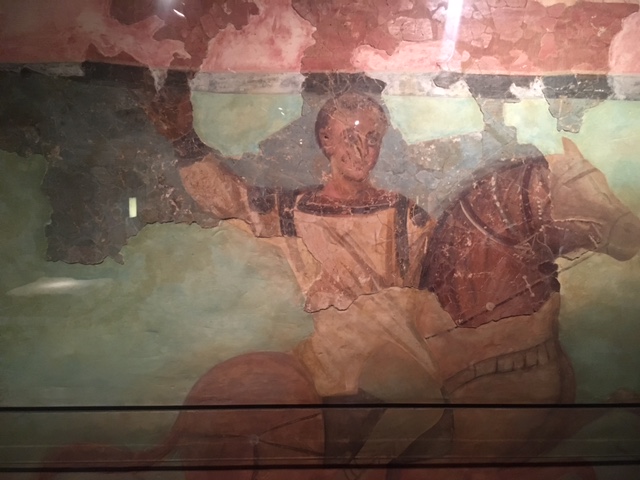
Next day, we were back in history mode as we got out early and took the metro to the Gothic Quarter for a visit to the Barcelona History Museum—sounds kind of ho-hum right?  Well, it wasn’t.  This museum was by far one of the best, most interesting places we’ve been so far on our trip.  Barcelona was founded as a Roman city with neolithic roots as far back as 5000 BC.  According to legend, Hercules founded the city, but for some reason, no one can prove it.  The Barcelona History Museum is built right on top of some of the most complete Roman ruins on the Mediterranean, and we spent the better part of two hours marveling at 2000-year-old history.  We traveled about forty feet down to the ruins and talked about how each civilization built on top of the previous one.  The ruins encompassed a full area of Roman city life with upper class dwellings, trade shops, wine-making factories (the average Roman consumed sixty gallons of wine a year, dang!), fish factories, and intricate water and sewer systems.  There were mosaic floors, decorative frescos, wine vats, funeral busts, and other wonders of the ancient world.  After our tour, we talked about the things we had seen and emphasized the use of inference to determine the aspects of life that were most important to the Romans.  I could go on and on about this place, but I won’t—I just wish that everyone I know and love could see it.


Roman Ruins

Roman Fresco

We spent some time strolling the Gothic Quarter and made a point to see the cathedral in the city center.  I took a quick look inside while the rest of the crew stayed in the square to take pictures.  Deena wanted to try some tapas dishes, so we found a restaurant with reasonable prices and enjoyed a lunch with a chicken skewer plate, flank steak plate, Greek salad, and several tapas delicacies.  There was a large screen TV near our table, and we enjoyed watching the Spanish version of "Wheel of Fortune" as we ate but had a little trouble solving the puzzles—go figure.  The Gothic Quarter has many twists and turns, and the streets and alleys open up into many hidden squares and plazas where we happily became lost for a while after lunch.  


Cathedral

Gothic Quarter

We made it back to the apartment mid-afternoon, and the kids settled in for some schoolwork while Deena and I walked a few blocks to the laundromat to wash our clothes.  In addition to Spanish and Catalan, there were instructions in English, so we were able to get the washer started quickly.  Barcelona is the capital of Catalonia in the Kingdom of Spain, and the citizens speak their own language and fly their own flag alongside the Spanish flag.  The situation is similar to the one in Ireland where English and Gaelic are both used.  We went shopping for dinner while the clothes were drying, and we made it back just as the kids were finishing their assignments.  After a quick supper of empanadas and croquettes, we caught a taxi and went back to Park Guell where we spent the rest of the evening walking through the Gaudi experiencia, a whimsical section of the park with colorful mosaics and unique design.  Antoni Gaudi was a prominent architect in Barcelona in the late 19th century, and his work is beloved by the citizens.  As the sun set over Barcelona, we sat on the high terrace of the park and talked about our short time in the city.  We agreed that of all the places we’ve been so far, Barcelona would be the place we could live for a while.


Gaudi Barcelona

Back at the apartment, we said our goodbyes to Diego and Carla since we had to get up at 4:00 the next morning to catch a 5:00 taxi to the airport.  They are a nice little family, and we’ve enjoyed staying with them for a couple of days.  The apartment was comfortable and located close to everything we needed for a fun stay in Barcelona.  As I’m typing the last few sentences of this post, we’re on our way to Amsterdam on a Vueling flight, and we should be there about 9:30 AM.  We managed to wake up on time and get everything packed with a few minutes to spare—we’re getting pretty good at the routine by now, and the process is a little less hectic than it was at the first part of our trip.  In the taxi on the way to the airport this morning there was a song playing on the radio called "All the Road Running," a duet by Mark Knopfler and Emmylou Harris.  It had a sweet sentimental sound with a soft fiddle threading through the melody.  It was a fitting tune for the moment, and it put our minds at ease as we readied ourselves for another trip and another city—adios Barcelona.

Monday, September 12, 2016

France - Au Revoir

Viewed from ten kilometers out, the abbey of Mont Saint Michel looks like a hazy medieval mirage.  We had seen pictures of this place in books and watched one of Rick Steves’ excellent travel programs that included the abbey, but viewing it in person is altogether different.  It seems like a giant Benedictine monk planted a brick, watered it, and watched as a place of pilgrimage and worship grew straight up from the rocks to soaring heights and straight out until it reached the edges of the island.  Medieval pilgrims had to time their visits carefully with the tides in order to make it out to the abbey safely and not get stuck there until the tides receded.  The Bayeux Tapestry depicts a scene where William the Conquerer stopped at Mont Sainte Michel to receive blessing for his quest and lost several men in the quicksand surrounding the abbey at low tide.  Fortunately, there is a wide causeway and free tram service for modern pilgrims; we stepped onto the island and began a steady climb to the top of the abbey.  

It took about two hours to drive to Mont Sainte Michel from Couseulles sur Mer; so the visit to the abbey was our only activity of the day, and we took our time strolling slowly up the narrow cobbled streets lined with small museums, restaurants, and shops.  This part of the island is touristy, but because all the shops are contained in original buildings, their presence does nothing to diminish the grandeur of this place.  

In the early 700s, the Bishop of Avranches commissioned a sanctuary to be built on Monte Tombe to honor the archangel, Michael.  Building continued slowly until the 10th century when the Benedicitne monks moved in and ramped up the activity.  Over the next few centuries, a village grew around the island as the abbey was enlarged and improved.  Each section was built to support the section above or beside, and the construction was very technical for its time and military in design.  Mont Sainte Michel resisted every English assault over the years and became a national symbol of France as pilgrims have continued to come to this New Jerusalem—paradise on earth.  We waited in a long ticket line near the front of the abbey, but once we gained entrance, we had plenty of time to take a winding, self-guided tour that led from one wonder  of the abbey to the next.  Our two favorite parts of the buildings were the refectory where the monks ate their meals in silence on long wooden tables and the great pillared crypt built in the 1400s to support the abbey chancel above.  From one side of the ramparts, we could see the walls of the abbey thickly covered with dark brown moss blending seamlessly with the rock foundation.  The view from the other side stretched out across the rock-strewn tidal flats to the pale blue sea several miles away.  

We made our way back down into the village and stopped for some snacks to stave off the hunger produced by our pilgrimage.  I wonder how the medieval pilgrims made it without gelato and frites.  Monte Sainte Michel is a unique and special place, and I’m glad we made the drive out to walk its streets and climb its many stairs.  Tomorrow will be our last day in France as we make our way to the Beauvais Airport by way of the town of Rouen.  We’ve taken in a lot of history in Normandy, and we’ve enjoyed our time here together in our place by the sea.

Mont Sainte Michel

Next day, we were up a little earlier to start the packing ritual and hit the road for Barcelona, Spain.  We left Courseulles sur Mer around 11:00, a bit later than we had hoped, but we needed to stop at a market for lunch supplies.  By 1:00 we turned off the motorway into the busy streets of Rouen, where we had hoped to spend a couple of hours walking around the city center and checking out the famous gothic cathedral in the main square.  Traffic was insane in this vibrant city—we were expecting a sleepy town like Bayeux, but this place was intense.  People  were walking everywhere and into the street at all times with cars rushing into the lanes from every direction.  We passed a few empty parking spaces going down a steep hill on the way to the cathedral,  and they were probably the only empty ones in the entire city—unfortunately we didn't take one.  We spent the next twenty minutes attempting to retrace our way up the hill dodging cars rushing around in a French hurry.  We found the spaces again, and I displayed my parallel parking wizardry to the delight of my passengers.  We ate a quick lunch in the car before striking out toward the cathedral, but we were concerned that our parking spot might require payment—the markings on the street were ambiguous, and we didn’t want to risk being towed three hours before the rental car was due back at the airport.  We walked to the cathedral anyway, and admired the front of the building that Claude Monet spent a whole year painting in a classic series.  The stonework was beautiful, but I thought the whole facade could use a good pressure washing.  We were too worried about the car to enjoy anything else, so we hoofed it back up the hill before a local gendarme could spoil our day.  We had hoped to spend more time in Rouen, but we hadn’t planned well enough to pull it off—lesson learned.  There were also no public restrooms to be found, so we had to get back on the road with two more hours to drive to the airport in Beauvais, and my back teeth were floating.  Somehow the rest of my crew can go to the bathroom once during the morning, and they are good for the day.  How is this possible?  They drink the same amount of water that I do.  To make matters worse, they make fun of me in the cruelest fashion.  

Rouen Cathedral

The little Citroen hummed along on the rural roads on the way to Beauvais, and I tried every Zen trick in the book to keep my mind off my distended bladder.  The Citroen was very fuel efficient, and we still had half a tank left after traveling close to 600 kilometers—I’ve been told this efficiency is due to the diesel engine, something about which I have no knowledge.  It’s a good thing the cars in France are so stingy with fuel because there are no gas stations anywhere to be found.  Not only did I need a "rest stop," but we were obligated to bring the rental car back with a full tank or suffer the wrath of the Hertz agent who wields power over credit card limits. We passed through no less than seven towns with nary a gas station to be found, but the local bar was always in plain sight.  A road sign advertising the proximity of a McDonald’s gave me hope for a bathroom, but it turned out to be a cruel lie.  

We finally made it to Beauvais and bypassed the airport in order to find a gas station, which we did after getting lost and driving around for fifteen extra minutes.  Good thing we bailed on Rouen.  The gas station attendant was  a nice young man who was eager to use his English skills, and we showed our gratitude by loading up on Cokes and Snickers bars after dominating the rest room, whew!  The airport wasn’t far away, but none of the signs were in English, so it took a while to get the rental car returned.  The Hertz agent solemnly walked around the Citroen with her clipboard as we held or breath.  To our complete joy, she released us with her blessing and charged us the appropriate rate.  I’m officially one for two in leaving rentals with my pride undamaged.  I asked one of the rental guys where we could pick up the shuttle to the terminal, and he looked at me quizzically.  I asked again, and he pointed across to the parking lot to the building that said “terminal" and said, “You walk.”  He left off, “stupid American.”  We hefted our bags on our shoulders and made the 200 meter walk to the terminal where I’m sitting typing frantically after consuming a moyen Americano, the first good coffee I’ve had in a week.  It’s really good.  Really, really good.  This airport is the smallest we’ve encountered, and it looks a lot like the interior of the Sears auto-service bay without the air conditioning.  It smells like sweaty, frustrated tourists, but at least it doesn’t smell like tires.  We board the plane for Barcelona in one hour with an expected landing around 11:00pm.  France has been fun, educational, and not as expensive as we had feared—we’ll miss it.  Au revoir!