Sunday, September 18, 2016

The Netherlands - Amsterdam


I can’t remember the first time I heard about The Netherlands, but I’m sure it wasn’t until I was into adulthood.  Growing up, I learned about Holland and saw pictures in books of Dutch people walking around in wooden shoes and funny white hats while dodging windmills and tending the tulips.  Now, I’m finding out that there are twelve provinces in The Netherlands, including North Holland and South Holland, but if one refers to the Kingdom of the Netherlands as Holland in general, it’s politically incorrect and downright offensive.  My childhood has been turned upside down in a two-day visit to Amsterdam, the capital of Holland….oops, I mean the Kingdom of the Netherlands, hope I didn’t offend anyone there.

Yesterday we flew from Barcelona, Spain, north along the length of France to Amsterdam arriving at 9:30 in the morning. After a 4:00 wake up and early airport arrival, we were wiped out but ready to explore this old city.  We’re lodging at the Shelter Jordan Christian Youth Hostel where Deena stayed twenty-seven years ago on a trip to Europe with her sister and two other friends.  The girls are on the first floor, and the boys are on the second in dorm-style rooms with bunk beds—I called bottom bunk right away.  There are large shower rooms on each floor and a dining hall right off the reception area. Everything is clean and orderly, and the staff is friendly and helpful….and young, very young.  I would estimate the average age of the staff and residents here to be about twenty-one, so Deena and I are ancient in their eyes, but everyone has been warm and respectful to us.  

We arrived too early to check into our bunks, so we stowed our luggage and spent a couple of hours wandering the streets along the canals, immediately taken in by the design of the city and its unique construction.  There are bicycles everywhere—either chained up along the streets and bridges or being ridden by ruthless people who refuse to slow down for anything except to roll a cigarette.  We had been warned by our Uber driver about the rudeness of the bicycle riders, and we could tell pretty quickly what he meant.  In the US, pedestrians are given preferential treatment and right of way, but in Europe they’re sitting ducks and easy prey for motorists and bicyclists.  Even the locals here don’t dare jaywalk as they do in other large cities, and they use the extra waiting time to smoke.  Yeah, they have those crosswalks and flashing yellow lights here, but it’s a sham.  On a positive note, the citizens of Amsterdam get plenty of exercise on their bikes as they ride to the market for tobacco, beer, and flowers.


We had hoped to visit the Anne Frank house early in our visit; so we headed in that direction and discovered a long queue of people holding tickets they had obviously printed themselves.  We found out from a docent that visits to the museum could be scheduled in advance and time slots booked online for morning and early afternoon visits.  Through the use of the smartphone, we also discovered that there are no online slots available for the near future.  Oh boy. The docent also told us that we could return at 3:30 PM to stand in line for the general admission tickets and try to gain entrance before closing time at 8:00 PM.  With no other options, we continued our walk of the city with hopes to return later in the day.

There is evidence that land was being reclaimed in this area as early as 1000 AD, but real settlement didn’t begin until the 13th century when building expanded beyond the original fishing village.  By the 17th century, Amsterdam was into its golden age, and it became the richest city in the world due to the savvy of its merchants.  Rembrandt perfected his genius in this time, and Dutch colonization proliferated around the globe.  The following centuries would bring financial decline, plague, and war, but today Amsterdam stands on the banks of the picturesque canals, still a powerful city of commerce and culture.  The city has a dark side as well with its red light district offering cannabis in coffee shops to backpackers on pilgrimages for a legal buzz, and sex shops offering every kind of hedonistic act dreamed up since the days of Corinth.  Curiously, almost every website with a top-ten list of things to do in Amsterdam ranks a visit to the red light district high on the list…so to speak.  I think we’ll stick to the boat tour and enjoy the architecture and gelato instead.


Back in the day, citizens of Amsterdam were charged a tax based on the width of their houses, so most homes were built narrowly and deeply—the Dutch way of sticking it to the man.  Along the canals, the buildings are about twenty feet wide and rise five or six stories, capped with bell shaped gables.  Like New Orleans, Amsterdam is built below sea level, and for the life of me, I cannot understand why city founders thought this scenario would lead to perpetuity.  Since the buildings were all constructed on wood pilings, they’ve shifted and sunk over the years, and some were intentionally built with a forward tilt to facilitate runoff from rain.  Because of their shape and position, the buildings give the streetscapes a hand-drawn, cartoonish look that one cannot resist photographing hundreds of times.  From the center of the front gable on each house, a sturdy three-meter wooden beam protrudes decorated with trim molding with a thick iron hook installed at the end.  I wondered about this detail until I saw a tradesman using a large pulley attached to the hook to pull supplies up to the upper floors of the building with ropes—very clever.  I learned later that due to the steep, narrow stairwells in the houses, furniture has to be moved with pulleys in and out of windows that were built overly large for this purpose.  I think that avoiding taxes has led to more innovative ideas than the space program.

We walked back to the hostel after our initial exploration of the city, checked into our rooms, and rested for a couple of hours before gathering the energy to try the Anne Frank house again.  By the time we got back to the museum, the queue stretched around the building and down the street for two blocks.  Like the Mona Lisa in Paris, the Anne Frank house has become the thing to do in Amsterdam, but the Anne Frank house has infinitely more worth than any piece of art in my opinion, and we were determined to wait out the line so our children could experience it.  

“The two of us looked out at the blue sky, the bare chestnut tree glistening with dew, the seagulls and other birds glinting with silver as they swooped through the air, and we were so moved and entranced that we couldn’t speak.”

Anne wrote those beautiful words in 1944 after two years of hiding in fear, and they move me to tears.  Most people are familiar with the story of the Frank family hiding in the secret annex of Otto Frank’s business, helped by four employees who provided them with food and necessities for two years.  I won’t go into the whole story here, but looking it up is worth the time, and so is reading Anne’s diary.  The horror of the holocaust is large and drenched with evil, and I have trouble comprehending the capacity humans have to be gutturally cruel to other humans.  The story of the Frank family helps me see what one small family endured, and it astounds me that at least six million other people endured it as well.  What gets me the most about Anne and her loved ones is that they almost made it.  After two years of hiding, they were able to listen to the BBC on a small radio, and hear that the Allies had invaded France on D-Day.  From that point, they kept track of the Allied advances through France and were hopeful about the war coming to an end.  Then they were betrayed, arrested, and moved into concentration camps where they all died except for Otto Frank.  

We toured the secret annex—a very solemn and moving experience for my family.  We had seen pictures of the rooms furnished, and we wondered why they are empty now.  We learned that Mr. Frank agreed to have the rooms staged with furniture to show how they looked while his family was hiding there, then requested they be emptied and remain that way to symbolize the void left by the death of the Jews at the hands of the Nazis.  What a powerful reminder and what a selfless act by Mr. Frank to share his story and his daughter’s writing.  Anne’s diary is a treasure and testament of hope under the stress and tension of being persecuted to death, and I was unaware that it was on display in the museum section of the house.  I stared at it for a long time, and even though it was written in a language I didn’t understand, just the sight of it stirred feelings of hope and courage and the simple desire to be kind.  Compared to two years of living in fear, standing in line for an hour was nothing, and the lessons we learned were everything.

We walked back to the hostel where we had signed up for dinner and enjoyed homemade Hawaiian pizza, salad, and fruit with yogurt followed by a Bible study with some of the staff members.  Since we’re staying on different floors, we’ve had a few logistical issues with things like toothpaste and electronics chargers, but we’re enjoying the youthful vibe at the hostel.  


The hostel serves breakfast from 8:00 to 10:00, and I was there at 0800 on the dot, ready for coffee.  I was up early and spent an hour writing in the courtyard before the rest of my crew came down to eat.  The air was cool with a light breeze, and I enjoyed the solitude while I contemplated the events of the day before.  The coffee was fresh and strong, made from  a large press that produced a layer of froth on top of the diner style cup.  I enjoyed it tremendously.  One by one, my family came down for breakfast, and we attacked hearty pancakes with butter and syrup that was thick and sweet, similar to molasses.  Properly fueled, we hit the streets of Amsterdam for a long walk to the train station in the center of town.  Our destination for the morning was the Corrie Ten Boom house in the neighboring town of Haarlem, about a twenty-minute train ride away.  It took a few minutes to figure out the ticketing process, but we were on our way in short order, and stepped off the platform ready to walk some cobblestone streets.  

The town of Haarlem was a major trading city through the centuries and still retains its medieval charm with gabled houses and merchant-lined streets.  We found the Ten Boom House after a fifteen-minute walk and waited outside in the alley for the free tour.  The members of the Ten Boom family were Christians living in the Nazi occupied Netherlands and saw it as their duty to help Jews escape persecution by hiding them in their home.  They were eventually betrayed and arrested but not before helping many Jews and members of the Dutch resistance to escape.  Corrie survived a Nazi work camp and went on to live a long life sharing her experience through books and speaking engagements all over the world.  After the tour, Deena and I talked to the children about willingness to help people in time of need even though it might result in harm.  Like Queen Esther, would we all be ready and willing to offer aid for “such a time as this”?  In the living room of the Ten Boom house, there was a piano with a singe sheet of music sitting in the stand on top.  The song was "You are My Hiding Place", one of my favorite songs of worship and a reminder that our hope in troubled times doesn’t come from money or governments, but from God, who is ever faithful and unchanging.  

You are my hiding place; You preserve me from trouble; You surround me with songs of deliverance. 
Psalm 32:7

The Hiding Place

We walked to the main square of Haarlem and ate our lunch at a cafe on the border of all the activity including a large wedding.  We enjoyed a relaxing meal of soup and panini sandwiches before finishing our time in the town with a little shopping, and after another short train ride, we were back in Amsterdam, ready for a boat tour of the canals.  The discount tickets provided by the hostel gave us an hour of cruising through the canals and seeing the city from a different perspective.  The audio guide was engaging as we bobbed on the water in the afternoon sun, but we were a little sleepy by the end of the tour.  On the walk back to the hostel, we stopped at a very efficient three-story McDonalds where the crew enjoyed sundaes while I savored a big cup of strong coffee.  Like nowhere else on the trip so far, I’ve had the easiest access to excellent coffee in Amsterdam, and I think it’s a fine city indeed.

Every other Friday night at Shelter Jordan is deemed Hostel Night, and guests are offered a free dinner with a short program and a long time of fellowship with other travelers.  We showed up early and enjoyed talking to one of the staff, a young Australian girl who had traveled to many of the places on our itinerary.  Many young people these days are vegetarian or vegan or something, and the meal catered to those lifestyles and consisted of mixed vegetables, roasted potatoes, and apple pie.  I think I could be a vegan for a few days as long as there’s apple pie.  We sat with Emerson, a delightful eighteen-year-old staff member from the US, who is in the middle of a gap year between high school and whatever life brings her way next.  For being so young, she was already well-traveled, and we enjoyed her tales of adventure and hearing about her duties at the hostel.  Deveny was inspired to hear that life can lead down many avenues, and with a good head on one’s shoulders, the opportunity to explore those streets is worth considering.

Deveny and Emerson

After checking out of our rooms at 10:00 AM, we spent the last morning at Shelter Jordan sitting quietly in the courtyard alongside our bags.  Deena had a bout of vertigo earlier that morning, and we thought it best to take it easy in the cool of the morning rather than tackle one more fast-paced walk along the canals.  Along with everyone we talked with at the hostel, Joseph and Deveny liked Amsterdam very much, and I wish we could have spent a few more days in this unique city, but the strain on the budget would have been difficult to manage.  Still, we had enough time to get a feel for the culture and enjoy the look of the city which is like no other in the world.  Of all the countries we’ve visited so far where language has been an issue, the Netherlands has been the easiest to manage.  English is the second language of the citizens, and they are fluent and eager to converse with Americans.  Most signs are written in Dutch and English, and we found that the streets in Amsterdam are easier to navigate than the travel shows would have one believe.  Our compass is pointed toward Germany now, but the next time I find myself in the path of a crazed, cigarette-smoking cyclist, I’ll yield and smile and remember Amsterdam fondly.

Goodbye Shelter Jordan


Thursday, September 15, 2016

Spain - Barcelona

A couple of years ago when talks about this trip were hot and heavy around our house, Joseph came to us and asked if we could go to the beach in Spain.  Up to that point he had not been totally on board with the journey, and we were surprised and pleased with his question.  We told him that we would make every effort to go to the beach in Spain, and today we made good on that promise…and how.  After another delayed flight, a taxi dropped us off at our apartment in Barcelona around 12:30 in the middle of the night, and our host, Diego, met us at the door with a warm greeting.  For the next few days, we’re staying with Diego and his wife, Carla, and their one month old baby girl, Odette.  Their apartment is located in the Carmel district of Barcelona about twenty minutes from the city center by car, and it’s situated on the second floor among a few other apartments over a pharmacy.  We moved our stuff into our rooms and collapsed into bed about 1:00 AM and slept until 9:00 AM the next day.  There is no air conditioning in the apartment, but we have fans in our rooms that help move the air around.  Joseph and Deveny are in bunk beds in one room, and Deena and I have a double bed in a room near the front of the apartment.  We took turns getting showered and dressed while the children slept, and then we walked down the street in search of a market to buy breakfast food.   We found a really good one just a couple blocks away where we bought bread, butter, and ham for just a few euros—a good brunch to get us energized for the day.

After several heavy days of history-focused travel, we determined that this day would just be a fun beach day for relaxing in a new city.  Barceloneta Beach was our destination—we learned later that the Discovery Channel considers this strip of sand the best urban beach in the world.  According to Google, the beach was about 30 minutes away by metro, so we were off to figure out a new subway system at the station a few blocks away from our apartment.  Barcelona is world renowned for the etiquette and manners displayed by its citizens, and we can bear witness to that claim as a local seƱora saw our uncertainty at the ticket machine and spent the next fifteen minutes guiding us through the process and then walking with us to ensure we got on the right line—wow!  The people in this city seem more relaxed than in the other cities we’ve visited so far—they’re quick to offer a friendly greeting and switch instantly to English once they’ve  determined we’re not local.  We arrived in the Barceloneta area and walked out of the air-conditioned metro to bright sunny skies and warm humid air—a perfect beach day. As we walked about a half mile down long a boulevard to get to the beach, we enjoyed looking at all the outdoor cafes with colorful awnings and chalkboard signs touting deals on paella and tapas dishes.  The prices were reasonable for meals, and we decided we would pick one of these restaurants for an early supper later in the day.  As we looked ahead, we could see the deep blue water of the Mediterranean Sea come into view, and our excitement level hit the top register.  For thousands of years, the Mediterranean has been a sea of commerce, war, empires, and today its waters provided us with some quality fun in the sun.

Barceloneta Beach

For ten euro, we were able to rent an umbrella for the day, and we found a good spot between the beach and the showers.  It was crowded, but navigable, and everyone there was in a good mood on a sunny day.  Meandering through the crowds, vendors sang the attributes of their blankets, sangria, mojitos, and even massages.  

The sand on Barceloneta is coarse grained and camel colored unlike the powdery sand on the familiar coasts of North and South Carolina.  At the shoreline the sand stops, and there’s a bed of smooth, multicolored stones about the size of a half dollar extending into the sea.  The stone bed is deep and makes for slow and difficult walking along the edge of the water.  The contrast of the Mediterranean Sea and the beach against the city and the sky is striking—a view we enjoyed all afternoon.  I’ve always liked beach combing, and a few years ago a dear friend got me hooked on searching for shark teeth.  I’ve amassed quite a collection since then, proudly displayed in a clear glass lamp in our bonus room.  If there are no shark teeth to be found, sea glass becomes my next target, and that was the case today on the shores of the Mediterranean.  I found several deep green specimens, one nice pale green piece, and one small shard that was amber in color.  They were all smooth and rounded like stones, tumbled through time by the sea against rock and coral to produce a compelling translucence.  I told my family that I was sure my sea glass pieces were fragments from ancient Phoenician wine-bearing amphorae lost at sea during a shipwreck, but they weren’t buying it.  The water was cool and refreshing, and we alternated between naps under the umbrella and strolling slowly in the surf.


Barceloneta Beach

Now, I’m not sure if they were running late, or if the drinking the water in Barcelona produces absentmindedness, but there were quite a few young ladies on the beach who had forgotten half their bathing suits.  We hadn’t planned on doing any schoolwork, but we sure got a lesson on human growth and development on this day.  As true Southern gentlemen, Joseph and I did the best we could to avert our eyes, trying to make nonchalant comments about the color of the sky or the arrangement of stones by the water.  The beaches of Europe are well known for their liberal clothing policy, and Barceloneta Beach was a prime example.  Late in the afternoon, Joseph and I were walking together along the beach, and through no fault of our own, found ourselves right smack in the middle of a topless beach pong match.  With apologies to Jerry Lee Lewis, I ain’t fakin’, there was a whole lotta shakin’ goin’ on.  Yikes, all we could do was offer a polite “Howdy, ma’am” and keep on walking.  I clapped Joseph on the back and commented that the beach here was a whole lot different from Myrtle Beach back home.  Joseph looked like he wanted to bury himself in the sand.  Eventually we started getting hungry, left our umbrella, took quick showers, and headed off to find supper.  What a fun day at the beach in a really cool place —Joseph got his beach visit in Spain, and we had the breast time ever.  Best…we had the best time ever.

We found a promising outdoor cafe on the way back to the metro station where the maitre-d’ seated us at the perfect table, out of the sun but with a good view of the street for people watching.  We ordered a big black cast-iron pan of paella, the tradiotnal Spanish dish of rice, vegetables, and meat cooked with saffron and other savory spices until it’s steaming hot and so unbelievably good we were soon scraping the sides of the pan for every last morsel.  Washed down with a couple glasses of sangria, it was the perfect way to end our day at the beach.  

Back at the apartment, we rested for a while before venturing back out to the Park Guell for a view of the city before dark.  Our section of Barcelona is much like San Francisco with plenty of steep hills to climb, and every destination comes with a good cardio workout.  The residents of Barcelona love their dogs, and they were out in force in the park as we wound our way up steep trails toward our vista.  We made friends with one energetic pooch who kept bringing us a pine cone to throw.  We had a great time watching him make acrobatic catches.  We finished this day in Barcelona with a commanding view of the city that stretched all the way to the Mediterranean and the horizon beyond.  

Paella 

Barcelona

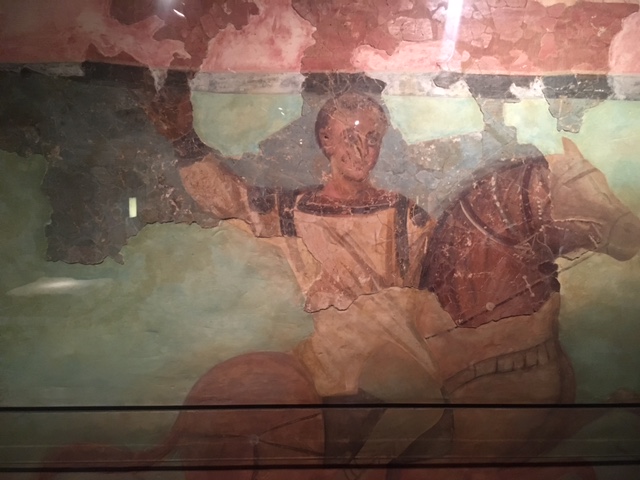
Next day, we were back in history mode as we got out early and took the metro to the Gothic Quarter for a visit to the Barcelona History Museum—sounds kind of ho-hum right?  Well, it wasn’t.  This museum was by far one of the best, most interesting places we’ve been so far on our trip.  Barcelona was founded as a Roman city with neolithic roots as far back as 5000 BC.  According to legend, Hercules founded the city, but for some reason, no one can prove it.  The Barcelona History Museum is built right on top of some of the most complete Roman ruins on the Mediterranean, and we spent the better part of two hours marveling at 2000-year-old history.  We traveled about forty feet down to the ruins and talked about how each civilization built on top of the previous one.  The ruins encompassed a full area of Roman city life with upper class dwellings, trade shops, wine-making factories (the average Roman consumed sixty gallons of wine a year, dang!), fish factories, and intricate water and sewer systems.  There were mosaic floors, decorative frescos, wine vats, funeral busts, and other wonders of the ancient world.  After our tour, we talked about the things we had seen and emphasized the use of inference to determine the aspects of life that were most important to the Romans.  I could go on and on about this place, but I won’t—I just wish that everyone I know and love could see it.


Roman Ruins

Roman Fresco

We spent some time strolling the Gothic Quarter and made a point to see the cathedral in the city center.  I took a quick look inside while the rest of the crew stayed in the square to take pictures.  Deena wanted to try some tapas dishes, so we found a restaurant with reasonable prices and enjoyed a lunch with a chicken skewer plate, flank steak plate, Greek salad, and several tapas delicacies.  There was a large screen TV near our table, and we enjoyed watching the Spanish version of "Wheel of Fortune" as we ate but had a little trouble solving the puzzles—go figure.  The Gothic Quarter has many twists and turns, and the streets and alleys open up into many hidden squares and plazas where we happily became lost for a while after lunch.  


Cathedral

Gothic Quarter

We made it back to the apartment mid-afternoon, and the kids settled in for some schoolwork while Deena and I walked a few blocks to the laundromat to wash our clothes.  In addition to Spanish and Catalan, there were instructions in English, so we were able to get the washer started quickly.  Barcelona is the capital of Catalonia in the Kingdom of Spain, and the citizens speak their own language and fly their own flag alongside the Spanish flag.  The situation is similar to the one in Ireland where English and Gaelic are both used.  We went shopping for dinner while the clothes were drying, and we made it back just as the kids were finishing their assignments.  After a quick supper of empanadas and croquettes, we caught a taxi and went back to Park Guell where we spent the rest of the evening walking through the Gaudi experiencia, a whimsical section of the park with colorful mosaics and unique design.  Antoni Gaudi was a prominent architect in Barcelona in the late 19th century, and his work is beloved by the citizens.  As the sun set over Barcelona, we sat on the high terrace of the park and talked about our short time in the city.  We agreed that of all the places we’ve been so far, Barcelona would be the place we could live for a while.


Gaudi Barcelona

Back at the apartment, we said our goodbyes to Diego and Carla since we had to get up at 4:00 the next morning to catch a 5:00 taxi to the airport.  They are a nice little family, and we’ve enjoyed staying with them for a couple of days.  The apartment was comfortable and located close to everything we needed for a fun stay in Barcelona.  As I’m typing the last few sentences of this post, we’re on our way to Amsterdam on a Vueling flight, and we should be there about 9:30 AM.  We managed to wake up on time and get everything packed with a few minutes to spare—we’re getting pretty good at the routine by now, and the process is a little less hectic than it was at the first part of our trip.  In the taxi on the way to the airport this morning there was a song playing on the radio called "All the Road Running," a duet by Mark Knopfler and Emmylou Harris.  It had a sweet sentimental sound with a soft fiddle threading through the melody.  It was a fitting tune for the moment, and it put our minds at ease as we readied ourselves for another trip and another city—adios Barcelona.

Monday, September 12, 2016

France - Au Revoir

Viewed from ten kilometers out, the abbey of Mont Saint Michel looks like a hazy medieval mirage.  We had seen pictures of this place in books and watched one of Rick Steves’ excellent travel programs that included the abbey, but viewing it in person is altogether different.  It seems like a giant Benedictine monk planted a brick, watered it, and watched as a place of pilgrimage and worship grew straight up from the rocks to soaring heights and straight out until it reached the edges of the island.  Medieval pilgrims had to time their visits carefully with the tides in order to make it out to the abbey safely and not get stuck there until the tides receded.  The Bayeux Tapestry depicts a scene where William the Conquerer stopped at Mont Sainte Michel to receive blessing for his quest and lost several men in the quicksand surrounding the abbey at low tide.  Fortunately, there is a wide causeway and free tram service for modern pilgrims; we stepped onto the island and began a steady climb to the top of the abbey.  

It took about two hours to drive to Mont Sainte Michel from Couseulles sur Mer; so the visit to the abbey was our only activity of the day, and we took our time strolling slowly up the narrow cobbled streets lined with small museums, restaurants, and shops.  This part of the island is touristy, but because all the shops are contained in original buildings, their presence does nothing to diminish the grandeur of this place.  

In the early 700s, the Bishop of Avranches commissioned a sanctuary to be built on Monte Tombe to honor the archangel, Michael.  Building continued slowly until the 10th century when the Benedicitne monks moved in and ramped up the activity.  Over the next few centuries, a village grew around the island as the abbey was enlarged and improved.  Each section was built to support the section above or beside, and the construction was very technical for its time and military in design.  Mont Sainte Michel resisted every English assault over the years and became a national symbol of France as pilgrims have continued to come to this New Jerusalem—paradise on earth.  We waited in a long ticket line near the front of the abbey, but once we gained entrance, we had plenty of time to take a winding, self-guided tour that led from one wonder  of the abbey to the next.  Our two favorite parts of the buildings were the refectory where the monks ate their meals in silence on long wooden tables and the great pillared crypt built in the 1400s to support the abbey chancel above.  From one side of the ramparts, we could see the walls of the abbey thickly covered with dark brown moss blending seamlessly with the rock foundation.  The view from the other side stretched out across the rock-strewn tidal flats to the pale blue sea several miles away.  

We made our way back down into the village and stopped for some snacks to stave off the hunger produced by our pilgrimage.  I wonder how the medieval pilgrims made it without gelato and frites.  Monte Sainte Michel is a unique and special place, and I’m glad we made the drive out to walk its streets and climb its many stairs.  Tomorrow will be our last day in France as we make our way to the Beauvais Airport by way of the town of Rouen.  We’ve taken in a lot of history in Normandy, and we’ve enjoyed our time here together in our place by the sea.

Mont Sainte Michel

Next day, we were up a little earlier to start the packing ritual and hit the road for Barcelona, Spain.  We left Courseulles sur Mer around 11:00, a bit later than we had hoped, but we needed to stop at a market for lunch supplies.  By 1:00 we turned off the motorway into the busy streets of Rouen, where we had hoped to spend a couple of hours walking around the city center and checking out the famous gothic cathedral in the main square.  Traffic was insane in this vibrant city—we were expecting a sleepy town like Bayeux, but this place was intense.  People  were walking everywhere and into the street at all times with cars rushing into the lanes from every direction.  We passed a few empty parking spaces going down a steep hill on the way to the cathedral,  and they were probably the only empty ones in the entire city—unfortunately we didn't take one.  We spent the next twenty minutes attempting to retrace our way up the hill dodging cars rushing around in a French hurry.  We found the spaces again, and I displayed my parallel parking wizardry to the delight of my passengers.  We ate a quick lunch in the car before striking out toward the cathedral, but we were concerned that our parking spot might require payment—the markings on the street were ambiguous, and we didn’t want to risk being towed three hours before the rental car was due back at the airport.  We walked to the cathedral anyway, and admired the front of the building that Claude Monet spent a whole year painting in a classic series.  The stonework was beautiful, but I thought the whole facade could use a good pressure washing.  We were too worried about the car to enjoy anything else, so we hoofed it back up the hill before a local gendarme could spoil our day.  We had hoped to spend more time in Rouen, but we hadn’t planned well enough to pull it off—lesson learned.  There were also no public restrooms to be found, so we had to get back on the road with two more hours to drive to the airport in Beauvais, and my back teeth were floating.  Somehow the rest of my crew can go to the bathroom once during the morning, and they are good for the day.  How is this possible?  They drink the same amount of water that I do.  To make matters worse, they make fun of me in the cruelest fashion.  

Rouen Cathedral

The little Citroen hummed along on the rural roads on the way to Beauvais, and I tried every Zen trick in the book to keep my mind off my distended bladder.  The Citroen was very fuel efficient, and we still had half a tank left after traveling close to 600 kilometers—I’ve been told this efficiency is due to the diesel engine, something about which I have no knowledge.  It’s a good thing the cars in France are so stingy with fuel because there are no gas stations anywhere to be found.  Not only did I need a "rest stop," but we were obligated to bring the rental car back with a full tank or suffer the wrath of the Hertz agent who wields power over credit card limits. We passed through no less than seven towns with nary a gas station to be found, but the local bar was always in plain sight.  A road sign advertising the proximity of a McDonald’s gave me hope for a bathroom, but it turned out to be a cruel lie.  

We finally made it to Beauvais and bypassed the airport in order to find a gas station, which we did after getting lost and driving around for fifteen extra minutes.  Good thing we bailed on Rouen.  The gas station attendant was  a nice young man who was eager to use his English skills, and we showed our gratitude by loading up on Cokes and Snickers bars after dominating the rest room, whew!  The airport wasn’t far away, but none of the signs were in English, so it took a while to get the rental car returned.  The Hertz agent solemnly walked around the Citroen with her clipboard as we held or breath.  To our complete joy, she released us with her blessing and charged us the appropriate rate.  I’m officially one for two in leaving rentals with my pride undamaged.  I asked one of the rental guys where we could pick up the shuttle to the terminal, and he looked at me quizzically.  I asked again, and he pointed across to the parking lot to the building that said “terminal" and said, “You walk.”  He left off, “stupid American.”  We hefted our bags on our shoulders and made the 200 meter walk to the terminal where I’m sitting typing frantically after consuming a moyen Americano, the first good coffee I’ve had in a week.  It’s really good.  Really, really good.  This airport is the smallest we’ve encountered, and it looks a lot like the interior of the Sears auto-service bay without the air conditioning.  It smells like sweaty, frustrated tourists, but at least it doesn’t smell like tires.  We board the plane for Barcelona in one hour with an expected landing around 11:00pm.  France has been fun, educational, and not as expensive as we had feared—we’ll miss it.  Au revoir!

Sunday, September 11, 2016

France - Normandy

On a rolling green hillside overlooking a peaceful sea, 9000 marble crosses face directly west toward a home to which these men never returned.  They are fallen soldiers who died on D-Day and other times of combat during World War II.  Most of the crosses bear names, but many are inscribed, “Known but to God,” their bodies retrieved from the battlefield but unidentifiable.  The American Cemetery is located on the coast of Normandy, France not far from the beaches the Allies invaded over seventy years ago.  The men buried in graves on this hillside in France died in horrible ways in a horrible situation, far from home and families in order to liberate a country, bring an end to a devastating war, and preserve freedom for the United States.  Yes, they died so that American citizens still have the right to speak freely about whatever issue they deem worthy, but after viewing these endless rows of crosses, some matters do not seem so weighty.  There is a mighty change of perspective when someone dies for another person.  The selfless act brings about a sense of humbleness and purpose and duty in the person who has been spared and perhaps perpetuates that same spirit of sacrifice in a selfish world.  At least we should all stop in our busy tracks every now and then, bow our heads and say a simple, “Thank you.”


We began our first full day in Normandy looking out to the sea from the sliding glass doors of our little beach condo in Courseulles sur Mer.  The places we wanted to visit were within easy driving distance; so we took our time and enjoyed a breakfast of eggs-in-a-basket with raspberries and bananas.  Our makeshift bedding served us well, and we felt rested after traveling the day before.  The coffee situation is not great, and there’s no tea and sugar for the girls because we don’t feel good about spending money on items we can’t finish before leaving a place, and packing space is at a premium.  We’ll survive somehow.  Showered and dried by the grace of our micro-fiber towels, we boarded the Citroen and began making our way to Omaha Beach and the D-Day museum.  After driving the narrow, unforgiving roads in Ireland, I navigated the French motorways with much less tension thanks to wider lanes and a familiar seating perspective.  There were still some tight places to negotiate in the small villages, but overall the driving experience was much more pleasant.  Views of the French countryside were also relaxing while motoring, and we enjoyed seeing another look of France, vastly different from Paris.  The fields stretched out from the highway and were golden from the grain cultivated there, close-cropped from recent harvests.  The trees and grass flanking the fields were half-green, spent from enduring another summer.  At times coveys of quail exploded from the thickets near the road, the birds surprised by the car and swirling in search of another quiet place.  In the short distance from the hills approaching small villages, we could see slate roofs streaked with lichen and tinged with grey-green patches of color.  We passed many time-worn homes and barns made from uneven honey-toned limestone bricks exposed under crumbling, weather-stained stucco facades.  The whole landscape had a faded feeling brought about by the passing of seasons and the horrors of wars fought there through the ages.

We arrived at Omaha Beach and pulled into the D-Day museum, circled the parking lot and dodged the tanks and propellers placed in the small medians.  We spent the next hour walking through the exhibits that included weapons, uniforms, documents from generals, and letters from soldiers.  The most unsettling displays were the cases full of German deaths-head uniform insignia, a helmet with a bullet hole punched through the center, and the shabby striped pajama uniform of a concentration camp prisoner.  Surprisingly, the focus of the most uplifting exhibit was a Nazi flag, its black swastika and red border still bold in color after seventy years.  Two American soldiers had overtaken a German bunker during the invasion and removed the flag.  One of the soldiers survived the war and took the flag back to the United States and kept it until the 50th anniversary of D-Day when he returned to the shores of Normandy and presented the flag to the town and museum.  We finished our time in the museum by watching an excellent movie in English that used real footage from the war to describe the planning, buildup, and execution of the D-Day landing.  Outside the museum it was bright and sunny with a clear blue sky and a constant, fresh sea breeze.  The beach was several hundred meters away, and we chose to walk so we could enjoy the nice weather.  Upon arrival  at the seashore, we saw a wide golden expanse of sand gently lapped by the small waves of a blue green ocean.  My children strolled onto Omaha Beach where seventy two years ago, the largest amphibian invasion in the history of the world took place, liberating France and resulting in horrific losses of life.  In the museum we witnessed scenes of war on this beach that included ships, machinery, smoke, and soldiers struggling to make it to shore, many of them dying from the relentless German machine gun fire.  The ugly German-constructed beach barricades looked like giant twisted nails scattered in the surf.  Now there is just wind and sand and sea.

The Children on Omaha Beach

A Perspective of the Omaha Beach Memorial

We drove thirty minutes to the west and arrived for a visit at Pointe du Hoc, one of the key areas of battle during the D-Day invasion and a place remembered for the bravery of the Americans who fought there.  Due to a navigational error and a late landing, the element of surprise was lost as 250 Army Rangers began their ascent of the ninety foot cliffs in an effort to dismantle the German bunkers at the top.  Pointe du Hoc is high ground positioned between Omaha and Utah beaches and was heavily fortified by the Germans to defend the coastline of Normandy.  Allied bombing failed to take out enough enemy positions, and the Rangers struggled to the top using grappling hooks and ropes while enduring heavy gunfire.  Of the 250 men who began the ascent, ninety made it to the top of the cliffs and gained control of Pointe du Hoc for the Allies.  We spent an hour walking the trails along the cliffs peering down at the ocean striking the rocks below.  Looking around we suddenly realized that the large grass-grown pits surrounding us were craters scooped out by Allied bombs during the invasion.  We ducked our heads and walked through the low concrete bunkers built and occupied by the Germans, their walls pocked by gunfire inside and out.  Some of the bunkers had been turned inside out by the bombing—giant concrete slabs pointing to the sky in surrender.

Our last stop on the beaches of Normandy was the American Cemetery, a testament to the cruelty and sacrifice of war at the hands of an enemy driven by the lust for power.  That enemy was put down, but the lives of the families of the fallen soldiers were altered forever.  We spent time wandering the rows of marble crosses, and I walked a long way down to the memorial chapel where I saw an elderly man sitting on a bench weeping, his wife holding his hand and stroking his cheek.  We spent some time talking to the children about how the Germans occupied France for several years before liberation came through the Allied invasion on D-Day.  The French are still grateful, and it shows in the dignified memorial and careful maintenance of this solemn, peaceful place.  Several years ago, we visited Minuteman Park in Massachusetts, and our hazy understanding of the American Revolution became clear as we walked the militia trail leading to battle with the Regulars.  In the same manner, my family came to the coast of Normandy, saw the beaches, understood the invasion, and said, “Thank you.”
American Cemetery Normandy, France

The town of Bayeux was our last stop of the day before returning home, and we went there to learn about another invasion that also changed the course of history.  In the middle of town across the street from the graceful old cathedral, we entered the museum that houses the Bayeux Tapestry.  I first learned about this ancient work of art a few years ago while reading a book entitled, 500 Places to Take Your Kids Before They Grow Up, and the tapestry made the list.  Commissioned by Bishop Odo of Bayeux, the brother of William the Conquerer, the tapestry is a 230 foot by 20 inch cloth embroidered with over fifty scenes showing the social, political, and cultural events leading up to the Battle of Hastings and William of Normandy defeating Harold to take the crown of England.  The tapestry is a detailed, glorious, one thousand year old comic strip that by some miracle has survived the centuries for all to enjoy.  The embroidery is done with gold, green, and red woolen threads that still have a colorful punch, and they must have been bold and vibrant in the 11th century.  We sure enjoyed it as we walked the length of the tapestry stopping at every scene while listening to the excellent commentary from the audio guide.  The whole experience took about a half hour, and at the end, we understood the Battle of Hastings in 1006 and its historical significance.  We passed through the gift shop on the way out and had to restrain ourselves from purchasing a Christmas ornament depicting Harold plucking the fateful arrow from his eye.  
Bayeux Cathedral

We celebrated our new historical knowledge on the streets of Bayeux with several scoops of gelato before walking uphill to the French gothic cathedral for a self-guided tour.  The cathedral was old and impressive, but we were so blown away by the tapestry that its former home didn’t do much for us.  American history and world history were big subjects for our homeschool today, and we learned much about major events that shaped the world as we visited the areas where they happened.  We arrived back in Courseulles sur Mer and cooked a spaghetti supper to celebrate a day of learning in an unforgettable place.


Saturday, September 10, 2016

Au Revoir Paris, Bonjour Normandy

“So, what was your favorite thing?”  That’s the question my family hears from dear old dad as every activity draws to a close.  I’m genuinely curious to learn about the one thing that stood out or meant the most to my wife and children as we prepare to leave areas that we’ve enjoyed and studied, and my hope is that the kids will have a special focused memory about each one.  Paris is an old city, but it still seems fresh and vibrant with lively, artistic flavor still prevalent in the streets.  The history is certainly there for the taking, but Paris moves forward with the winding of the Seine, the hard edges of the years softened by a desire to enjoy life in the midst of a troubled world.  The people of Paris live in a cool place, and they know it.  Our favorites:  Notre Dame will always have my heart with its gargoyles, flying buttresses, and historical bear hug; the art and architecture contained by the Musee d’Orsay captivated Deena the most; Joseph said he would never forget ascending the metro stairs to La Place de Concorde on our first day and taking in the city for the first time; Deveny loved la Tour Eiffel, and she was in her element as we enjoyed our last night in Paris together on the grounds of this Parisian icon.

La Tour Eiffel in Daylight
La Tour Eiffel at Night

We spent two hours lost in the panorama of the City of Light from the second floor of the Eiffel Tower thanks to the blessing of a gift from our dear friends, Brent, Wilkie, Emily, and Grant.  Our elevator ride was scheduled for 9:30 PM, but we arrived a couple of hours early while there was enough light to sit in the surrounding park and view the tower as the sun set.  Couples and groups of young people were picnicking on the grounds, their blankets serving as small cafes complete with baguettes, cheeses, and bottles of wine.  We found the spot designated to meet our tour group and sat in the grass for an hour and watched as the tower came alive with interior lighting.  The area surrounding the tower is blocked by metal barricades, and entry can only be gained through a security checkpoint.  All around the perimeter of the barricade, the swell of tourists grew with the setting of the sun.  Street vendors hawked Eiffel Tower key rings under electronic signs that flashed warnings about buying from street vendors; and neon tracers followed bicycle taxis as they carried passengers drinking champagne.  At the top of every hour after sunset, there is a light show, and we sat eagerly watching as 9:00 approached, not knowing what to expect.  We all shouted with delight as the hour came and the tower came alive with darting pinpoints of light that looked like an assault from thousands of fluorescent fireflies.  We sat transfixed for the duration of the show wishing it would continue all night.  

When we found our tour group, the guide gave us a concise history of the Eiffel Tower—I was interested to learn that it gets repainted every seven years, and it takes fifteen months to complete the job.  Two security checkpoints later, we boarded the elevator and ascended to the second floor where we had plenty of time to walk around and enjoy the commanding view of Paris at night.  We had difficulty processing the fact that we were on the Eiffel Tower.  The whole time seemed like a wind-swept dream as we walked the platform taking pictures and trying to pick out landmarks in the distance.  The light from boats marked the Seine, and we could see the towers of Notre Dame and the dome of Sacre Couer.  We had spent most of the day resting in our apartment knowing that we would be out late on our last night in Paris, and we were thankful for our energy reserve as we were completely absorbed in our experience on the tower—we had an amazing time.  After we descended, we walked toward the Trocadero Plaza, and turned around to view one last light show before leaving.  The plaza was full of people watching the tower, and there was a group of couples doing the tango to music punching through loudspeakers.  We sat silently during the long metro ride back to our Bercy neighborhood, each person lost in thoughts of Paris at night, and Deveny was remembering her favorite thing.

On the Tower

We were up early the next morning and solemnly began our packing ritual knowing our time in Paris was drawing to a close.  Deena and Deveny walked down the street to the corner bakery to get breakfast while Joseph and I pressed on with the packing.  He had stayed up most of the night to watch the Carolina Panthers game through some form of media setup devised with his buddy, Grant.  Although sad that the Panthers lost, he somehow summoned the motivation to pack.  The girls returned with all kinds of pastries, including apple tarts, eclairs, and chocolate croissants that once bitten, melted into buttery bliss.  We drank or last cups of coffee and tea, collected our bags, took one last look around, walked into the hall, and sadly closed the door to our wonderful Parisian apartment. 

Our Parisian Apartment

Surrounded by our belongings, we took one long, last metro ride to the bus station where we waited to board a coach to Normandy.  A pack of heavily armed security officers paced back and forth through the platforms occasionally asking travelers for their documents, and they pushed one guy against a wall and gave him a good frisking.  The whole scene was creepy, but we got used to seeing things like this around the city because heavily-armed security prowled every crowded plaza and tourist destination.  We discussed how sad it is that the lively City of Light always has a backdrop of tension and fear due to past and predicted terrorist attacks.  I confess that I breathed a sigh of relief as we left a few areas, and it’s obvious that armed security can do nothing to prevent attacks, but they try to keep casualties to a minimum once they occur.  I pray that the plans of these terrorists are foiled at every turn.

Deena told me that the three hour drive to Caen in Normandy was full of beautiful scenery, but we missed it all due to the deep sleep that enveloped us as we traveled in the comfort of the roomy coach.  We arrived in Caen around 2:00 PM, and the realization that I had to drive again in a foreign country slapped me in the face.  At least the French drive on the correct side of the road, and I steeled myself for the challenge.  We walked a few blocks to the Hertz office where our agent was efficient and friendly, and before long we were headed out into the streets with our peppy little Citroen—another car with a straight drive transmission, but manufactured with the steering wheel and the gear shift in the right place.   

The roads were well marked, and we easily found our way out of town headed to the village of Courseulles Sur Mer located in Juno Beach, the area where the Canadian forces landed on D-Day.  We stopped at McDonalds on the way for a late lunch, and I was amused to order a Royale with Cheese, an act in which a few readers may find humor as well.  We had booked a small condo on the beach through AirBnB, and we pulled up to the building and waited on the guy to show up with the key for over an hour.  He was cheerful, though, and gave us a quick tour of the place.  Through our terrible French and his terrible English, we were able to determine that our place had everything we needed except wifi, sheets, towels, toilet paper, paper towels, soap, dish towels, coffee, and most importantly, a cork screw—sacre bleu!  He finished with a cheerful, “Ees pairfect, no?”  No.  Fortunately, we had packed down sleeping bags and micro-fiber towels, and we now made pillow cases out of t-shirts.  The other things were remedied with a quick trip to the local market, and we found free wifi down by the beach provided by the town.  So, we had pizza for dinner and settled into our new headquarters by the sea and prepared ourselves for one of the most important history lessons of our entire trip, ees pairfect, no?


Sunset over Courseulles Sur Mer, Normandy


Thursday, September 8, 2016

Paris - The Louvre


“We’ve seen a lot of Greek sculptures, and a lot of them look alike.  They’re all really good, so what makes the Venus de Milo so special?”  An excellent question raised by Joseph after viewing one of the Big Three exhibits in the Louvre, and I thought about it the rest of the day and into the night as I lay in bed not sleeping.


We spent most of the day in our apartment resting, doing schoolwork, and preparing meals.  The sun finally returned to Paris, and its rays seeped through our windows as a soft, steady breeze gently pushed the curtains from the walls.  From the top of our building between the sounds of passing cars, we could hear the pigeons cooing, sounding content in the warm sunshine.  With most of our list of must-do activities in Paris complete, we enjoyed the time together anticipating a late afternoon visit to the Louvre.  No trip to Paris is complete without touring the most famous art museum in the world, mainly to be able to answer “Yes, we went to the Louvre” to inquiries from friends and family about time spent in the City of Light.  


OK, let’s get real here.  Despite the fact that the Louvre houses thousands of priceless treasures from the world of art spanning the millennia, the majority of visitors go there to see the big three:  the Winged Victory, the Venus de Milo, and the Mona Lisa.  One of the three is headless, and another is lacking arms, for crying out loud.  There are people out there who try to set records for Louvre visits with the big three pieces as the only targets, and I think six minutes is the current mark.  As Deena and I planned our visit, before checking the internet, we could not come up with any other pieces of art we wanted to see in the museum other than the big three, and we had already seen them over twenty years ago.  We used our British Museum strategy and viewed several Louvre highlight lists then narrowed it down to our own top ten.  We did not have the luxury of time as we did in London, and there was no point in frantically running down the halls of the museum trying to see everything, so we came up with a good list of pieces to view, most of which we had never heard.


The sky was brilliant blue on this day, and as the sun cast shadows on cornices and arches, we enjoyed a new perspective of the buildings of Paris previously hidden to us by the cloudy weather .  Our metro stop put us right in front of the side access to the museum entrance, and I. M. Pei’s glass pyramid came into view as we got closer.  The shape of the Louvre is a massive U, and it surrounds a vast courtyard with the pyramid entrance in the center.  There was no shelter from the sun, and we could feel our necks already starting to burn as we joined the long queue of potential visitors.  After thirty minutes, we had moved about thirty feet. I did a little quick figuring and determined that based on our current trajectory and speed of movement, we would reach the entrance in about two hours.  

We began a discussion about whether or not we should continue our present course, but no member of the crew was willing to accept responsibility for a definitive decision.  I had a serious mind game going on inside my head envisioning a good dad dressed in white on my right shoulder and an evil dad dressed in red on my left.  The good dad was whispering in my ear, “You should wait it out.  You have two bright children with you who may not have another opportunity to see the Mona Lisa.  They will be denigrated by all their friends and family when it’s discovered they went to Paris and didn’t visit the Louvre.”  The evil dad was whispering, “You should bail.  What’s the point of standing for hours in the sun just to see three pieces of art?  You can save the thirty euro and put it toward a relaxing boat ride on the Seine instead.”  The tension of this debate was palpable, and I was on the verge of opening my mouth to utter a decision when a museum guard walked out, lifted a rope, and motioned the whole queue inside the museum—our destiny was clear, and I was off the hook.  We found out later that a computer glitch knocked out the ticketing system, and the long queue was the result of the lengthy effort to fix it.


The folks at the Louvre are well aware of how their artistic bread is buttered, and there are signs with pictures of their resident celebrities posted everywhere with arrows pointing out the paths to their rooms.  Our strategy was simple:  we’ll make our way to the big three with the rest of our top ten exhibits in mind, locating them through inference based upon the system of categorization employed by the Louvre.  Within ten minutes of purchasing our tickets, we were standing in front of the Winged Victory taking note of the intended viewing angle—one side is rough hewn; the other is graceful and delicate.  Within another twenty minutes, we were in the hall outside Mona Lisa’s chamber, and we could see her enigmatic smile through bulletproof glass from across the room.  Between two bored security guards and a swirling mosh pit of tourists, jostling for position presented a formidable obstacle for our children to view this renaissance gem, and we left them to their own methods.  With smartphones in hand, and the devil-may-care  attitude that only teenagers possess, the kids cut through the crowd, took their photos, and within a couple of minutes, Deena and I were validated as parents.


Within another thirty minutes, we were in the hall of Greek sculpture viewing the Venus de Milo in the midst of a much smaller and friendlier crowd.  There is no questioning the beauty of this sculpture. Even though she’s stationary, she still has the appearance of movement as if in the process of turning, and her thin, graceful cloth covering appears ready to slither down her hips at any moment.  The experts still can’t agree who pulled this thing of beauty from a block of marble, but whoever it was got it right.  We wandered through the rest of the rooms viewing the mostly male Greek sculptures, and now in addition to being a painter, I’m qualified to be a urologist as well.  Nudity is the main theme here in the Louvre, and we’ve seen more skin here than on a long stretch of Myrtle Beach on a sunny day in July.


We spent the better part of two hours touring the Louvre and managed to see most of our top-ten items on the way to visit the rock stars.  My favorite items were the Botticelli frescoes with centuries-old lime leaching through the pigments in the plaster giving them a frosty appearance that was exquisite.  In the hall outside Mona Lisa’s room, Deena enjoyed several other paintings by Leonardo Da Vinci that were masterful and engaging and had no crowds around them.  We all enjoyed the huge, granite sphinx, one of the largest of such statues accessible outside of Egypt.  The last piece of art we made an effort to see was Liberty Leading the People, painted by Eugene Delacroix in 1830, a work that has come to symbolize the national pride of France.  In keeping with the theme of the Louvre, Lady Liberty can’t keep her dress up and doesn’t seem to care a lick about it.


So, back to my son’s question:  what makes the Venus de Milo so special?  I found a couple of quotes from two perspectives, the first from Jonathan Jones writing for The Guardian:  “The Venus de Milo is an accidental surrealist masterpiece. Her lack of arms makes her strange and dreamlike. She is perfect but imperfect, beautiful but broken—the body as a ruin. That sense of enigmatic incompleteness has transformed an ancient work of art into a modern one."  The second quote is from writer Karen Opas on the Quora website:  “What sets it apart is marketing. During the late neoclassic period the French ruling class and intelligentsia, perhaps unconsciously trying to reassert cultural dominance after their military losses, put out a lot of 19th century PR about the amazing qualities of the Venus de Milo.”  


I think the same things can be said about each member of the Louvre trinity—the hype brings the masses through the doors, and their beauty captures them once they stand in their presence.  Are they any better than other masterpieces displayed in other parts of the world?  Perhaps, but art is subjective and open to the interpretation and individual enjoyment of the person standing in front of it at the time.  As parents, Deena and I feel an obligation to show and teach our children as much as we can, and with some loving guidance, help them to see which objects of art are worthy of consideration as they relate to history.  From that point, they can decide which ones make them smile the most—isn’t that what art is all about?  So, we went to Paris, and yes, we visited the Louvre.

The Louvre