Thursday, March 23, 2017

Bali - Boulevard 66


Dogs generally bark, yelp, or whine, but our canine friends are not expected to "scream."  I woke up early on our second day in Bali, and after I applied the first bug-spray layer of the morning and began coffee prep, I noticed all the dogs in the neighborhood were screaming.  They were joined by the local rooster’s union to produce a banshee chorus that raised the hair on the back of my neck.  Just when I began to seriously wonder about the source of their extreme agitation, I heard a loud rumbling like the approach of a heavy diesel truck—and the world began to shake.  The walls were contorting, the ceiling fixtures were swaying, the water in the pool was choppy, and the floor was unsteady under my feet.  This was the first earthquake that I had ever felt, and it came on so quickly that I just froze in place not knowing how to react.  It ended after about thirty long seconds, and Deena emerged wide-eyed from the bedroom to join me in my astonishment.  Deveny said sleepily that she felt it and then rolled back over, and Joseph never awoke at all during the shaking. I guess it takes more than a 6.5 earthquake to impress our professional snoozers, but it sure got my attention.


We arrived at the airport in Denpasar, Bali, around 7:00 PM night before last, and as our transfer driver, Yayo took us through a labyrinth of dark streets to our house, I felt helplessly lost, a feeling that was amplified by the fact we had no food and hadn’t eaten in six hours.  Yayo kindly stopped at a market on the way, and we grabbed a few necessities like Pringles, eggs, and Coke, and I then knew we would survive through the night.  We finally arrived at Boulevard 66, our home on Bali for the next seven days, and Yayo twisted a key into the padlock which secured the chain on the front, and we walked into one of the most interesting houses in which we’ve dwelt in quite some time.  The main area resembles a large pool cabana with the rear completely open leading to a slate patio with an ornately carved gazebo bed in the center of the floor.  The two main bedrooms are enclosed with strong air conditioners mounted on the walls, and the four wide louvred doors at the front of the house open to a small pool tiled with sandstone and bordered by thick tropical plants against white stucco walls.  


I would like to say that the feelings shared by my crew that first night were joyful based on our cool new digs, but we were tired, the girls were concerned about bugs, I was worried about security, and Joseph was in his usual state of starvation.  We settled in a bit and walked down the road to a row of food vendors and ate a late supper of fried chicken and rice at a wooden table in a small shack with a dirt floor and a persistent pooch begging at my elbow.  The meal was accompanied by a strange soft drink with a flavor that brought horses to mind, but the food was decent and filling, and we all survived the diarrhea test through the night.

Bali Fried Chicken

The light of a new day always brings hope and a brand new perspective, and Deena and I explored the kitchen until we found all the cooking elements needed to prepare our favorite breakfast, eggs-in-a-basket, which we haven’t enjoyed in almost eight weeks.  We opened the louvred doors and enjoyed our meal in the cool morning breeze as the neighborhood came to life with the sounds of puttering motor scooters, roosters, and the locals greeting each other on the corner outside our stucco walls.  The kids settled in to start final testing on some of their subjects, and Deena and I walked around the block to meet our neighbors and check out the surroundings.  The houses and businesses nearby are right on top of each other, and they all have the aged pastel facade common to southeast Asia with once-red-barrel-tile roofs now blackened with mildew.  The streets were paved with concrete at some point in the last century, but they’re about halfway back to a dirt road with no highway crews in sight.  All of this well-seasoned civilization is set into an intense green tropical landscape that makes the whole scene charming to behold.


About midday, after we heard a loud knocking on our gate, two guys from the local motor scooter rental place rolled into our courtyard with two Honda machines .  The beaches and services on Bali are spread out and having a cheap mode of transportation is a necessity, so we chose the motor scooter method.  We got all the business stuff out of the way with the guys, and they showed us how to turn the machines on and work the kickstands, and they were off leaving us to figure out how to ride them.  For three months, we’ve watched little kids, old ladies, and everyone in between ride these scooters, many times carrying ladders, dogs, and even whole families—how hard could it be, right?  Deena started out by gunning her machine into the stucco wall across the street, where it fell over in the weeds on her leg which was burned by the exhaust pipe—the wheels were still spinning because her hand was still in place on the throttle.  We spent an hour practicing in the street much to the neighbors’ delight, and some little kids made themselves comfortable in the shade on the corner and watched our shenanigans with big grins on their faces.


I had some experience on motorcycles many years ago; so I more or less got the hang of riding the scooter after a while, and I set off with my biker babe on the seat behind me to explore our part of the island.  We rode all the way down to Balangan Beach, home of the best surfing on the island, and checked out lounge chair rentals for the next day.  On the way back, we found a promising grocery store and stocked up on supplies to get us through the next couple of days—and then we headed home to feast on peanut butter and jelly sammiches.  We still felt adventurous after lunch and left the kids to their studies while we took off up the mountain behind our village in search of an ATM, which we found in a convenience store that also had chocolate almond ice cream bars.  Flush with cash, groceries, and a modicum of experience on the scooter, we called it an afternoon. Feeling satisfied with our exploration, we spent some time resting on the fluffy pillows in the giant papasan chair at home.  Until Deena feels more comfortable riding a scooter, we’ve decided that I’ll be in charge of delivering everyone to our destinations and back, and we tested our system by motoring to an Italian restaurant where we had our fill of delicious pizza.

Born to be mild

After dark, we spent the majority of the evening in the pool talking and laughing, and we realized that we loved our home at Boulevard 66 with all of its quirks as well as its beautiful setting, and at twenty dollars a night, we felt like we were stealing again.  Deena and I plopped down in the papasan chair for a while and enjoyed the evening breeze and did a little research on New Zealand, which is fast approaching.  After our first big day on Bali, we went to bed and slept soundly and heeded no nightly noises coming from the village and the tropical province beyond.


Bali is one of thousands of volcanic islands that make up the Republic of Indonesia which was established after World War II after centuries of colonial rule by the Dutch, British, Portuguese, and French, all drawn to the region by natural resources and trade routes.  The nation has a population of 260 million, four million of whom were shaking along with us on our second morning during the earthquake.  Living on volcanic islands means that one must put up with earthquakes and tsunamis every now and then, and I wonder how long it takes to get used to it—after our experience yesterday, I don’t think I ever would.  


Maybe the constant threat of natural disasters is one of the reasons there are over twenty-thousand shrines and temples spread out over Bali. The natives practice a form of Hinduism which includes the worship of major and minor gods, Buddhist figures, and ancestors, with a little mysticism and magic sprinkled in as well.  Late in the afternoon of our first day, a local wearing a tie-dye sarong and sporting long hair and a curly gray beard opened our gate and waved hello as he walked to the back of the pool with a wooden box, and I assumed he was the pool man stopping by to check the chemical level in the water.  


The cleaning lady pulled up a few minutes later with her shy and smiling little boy whom she plopped down on the gazebo bed to sit while she set about mopping the floors.  Soon, the smell of incense got stronger, and the pool guy emerged from the bushes, waved goodbye, and placed a small basket made from palm leaves full of marigold and orchid blossoms and smoldering incense on the street in front of our gate.  When the cleaning lady finished, she took her little boy into the bushes behind the pool and emerged with a similar basket, which she also placed in front of our driveway.  Turns out the “pool man”  is a local shaman who I guess the owner keeps on the payroll to bless the house, and the cleaning lady offers a blessing of her own every time she visits. My discovery of a large shrine in the bushes behind the pool gives evidence for these rituals—so we’ve got that going for us.


After the earthquake, it was business as usual, and we had leftover pizza for breakfast, and while the crew made themselves ready for a day at the beach, I took one of the scooters into the village to fill it up with gas.  All through southeast Asia, I’ve noticed small markets with shelves by the street that stocked repurposed, liter-sized Coke bottles full of liquid the color of urine, which I assumed to be some sort of homebrewed tea for sale.  On our way to Angkor in Cambodia, I observed our tuk tuk driver pull over beside one of these markets where the proprietor poured the contents of one of these bottles into the gas tank, and I realized this was the southeast Asian version of the service station where one can fill up the tank and also purchase a live chicken instead of a Snickers bar and a 44 ounce Polar Pop.  I motored up to the local filling station and topped off the tank with a couple liters, which only set me back a dollar or so, and spent the next half hour taking my family to Balangan Beach a few kilometers to the west of our village.


Deena negotiated with a local hustler and scored an umbrella and chairs where we set up camp for the next few hours.  The beach was beautiful with golden sand and ice blue surf, and the high cliff borders on each side created a secluded cove where surfers flocked to catch waves.  The day was cloudy, but we enjoyed our time on the seashore with coconuts washing up in the surf along with an old dugout canoe.  We stayed past lunch, and I shuttled everyone back home where we spent the rest of the afternoon in the pool.  We walked to a restaurant in the village for a delicious dinner and then returned home—where the highlight of the evening was when a dark gray mouse crawled out from the cushion on the floor sofa right beside Deveny’s leg—needless to say, mayhem ensued.  Life in the tropics will still take some assimilation, but we have several more days to figure it out, and we’re looking forward to exploring more of the island.


Tuesday, March 21, 2017

Singapore


“Attention! Ladies and gentlemen!” The voice of the male flight attendant came over the intercom and pulled all of out of a deep sleep.  “The Malaysian government requires the cabin to be sprayed prior to arrival; so please cover your nose and mouth and prepare for the fumigation.”  Good grief!  The fumigation?  I quickly looked around to see if hoses were dropping from the ceiling of the plane or if guys in hazmat suits carrying pump sprayers full of disinfectant were making their way down the aisle.  Turns out, the “fumigation” consisted of a flight attendant walking the length of the plane spraying an aerosol can above the baggage bins, which created an orange-scented cloud that descended upon the passengers.  Not altogether unpleasant but strange, to say the least.  We touched down at the airport in Kuala Lumpur at 6:30 PM and spent the next two hours hustling through the terminal claiming one bag, checking in for the next flight, wolfing down dinner from McDonald's, and going through one more security check.  By the time we reached our gate, the flight was ready to board, and we were off to Singapore as a long travel day continued. We already missed the comfort of the Wheel Garden residence in Siem Reap.


We arrived in Singapore at 10:30 PM and went through one of the smoothest immigration procedures we’ve experienced to date and walked to the front of the airport where we quickly secured an Uber ride.  After a smooth trip on wide, clearly marked roads, the driver dropped us off at a twelve-story highrise. We rode the elevator to the top floor, found our unit, and then waited for an hour outside the locked door because the person scheduled to let us in was late.  By the time we fell into bed it was 1:30 AM, and we were done.   Rents are very high in Singapore; so we had to secure a private room in an occupied apartment, but as providence prevailed, the owner was traveling to Hong Kong for the weekend, and we had the place mostly to ourselves.  Our room is very tight with two single beds along the perimeter and a mattress on the floor between the beds.  We have our own bathroom, but the hot water isn’t functioning, so we’ve been granted permission to use the shower in the owner’s bath.  The owner’s friend, Andi, pops in and out unannounced, so we’re doing our best to stay organized and inconspicuous, but it’s difficult in such small quarters.


The apartment is small with a long narrow living room combined with a kitchen and two small bedrooms.  There are no closets or pantries, and the owner’s belongs are stacked neatly along the length of the walls and on shelves bolted above the small appliances that fill the kitchen counters.  The walls are painted egg-yolk yellow bordered by white trim, and the floor is tiled with black and gray granite.  The only air conditioners are in the bedrooms, so the windows in the main room are open all the time to take advantage of the cross breeze. Large floor fans help to break up the humidity.  There’s a washer in the corner of the kitchen, and just outside the rear window under the sill are six-cylinder shaped receptacles in which long sticks full of clipped clothing can be placed for drying like flags flapping to celebrate Laundry Day.  According to one of our Uber drivers, most Singapore citizens live in high-rise apartments just like the one in which we’re staying, so I guess we’re experiencing life in the city the way it really happens.


Singapore is actually a city-state which goes by one name denoting its sovereignty like the Vatican, and this one name gives it a lot of street cred as it does for mononymous people such as Plato, Voltaire, and Cher.  Colonial Singapore was founded by Stamford Raffles (one of the all time great personal names) in 1819 as a strategic port for the East India Trading Company (one of the all time great business names) and was occupied by the British.  The Japanese controlled Singapore during World War II and was included with Malaysia until seceding and gaining sovereignty in 1965.  Since that time, Singapore has grown to become wealthy with some of the lowest unemployment rates and one of the best infrastructures in the world.  I’ve formed impressions in my mind of the way places we’ve visited might look based on research and pictures, and by and large, most of those images have turned out as expected with the exception of actual life on the street.  I can say without hesitation that Singapore looks nothing like what I had expected, and it’s the most beautiful city I’ve ever visited.


Due to the late night and travel hangover, we took our time getting out of bed Saturday, but eventually hunger and my desire for coffee motivated us to throw on some clothes and explore the neighborhood.  Thankfully, the highrise next door had an open first-floor breezeway lined entirely with food vendors called hawkers in Singapore, and the area was anchored by a coffee shop with a no-nonsense proprietor.  This guy was gruff and covered with buddhist monk-style tattoos, and he made an excellent strong brew by straining fresh grounds through cheesecloth into a stainless steel pitcher.  His cheerful smiling daughter poured the finished product into clear glass mugs pre-filled with sugar and finished with a swirl of condensed milk.  As we walked with our steaming mugs, we discovered an Indian Muslim hawker's stall that specialized in various forms of prata, a thin fried dough similar to a crepe filled with egg or cheese and served with a spicy sauce.  We loved these tasty things, and they served as a hearty breakfast every morning of our visit.

They use the whole chicken, it makes the difference

The four languages spoken in Singapore are Malay, Mandarin, Tamil, and English, and most residents are fluent in at least two of these with English serving as the common bridge across the communication barrier.  All of the signs around town are written in English, and the Uber drivers speak it fluently; so we used this excellent service and app as our means of transportation while we explored the city.  Since we got a late start, we decided to hang around the apartment so the kids could work on school stuff, Deena could research New Zealand, and I could write.  Our goal was to attend the 5:00 PM Saturday evening service at the International Baptist Church preceded by stroll around Chinatown and a late lunch— which was a good plan that would have worked perfectly if we hadn’t given our driver the wrong address.  


We typed the address of the Chinese Heritage Center into the Uber app, and our driver who looked like the Asian version of David Bowie, arrived a few minutes later, and we eased into his sleek, black Mercedes-Benz ready to tackle the city.  About twenty minutes into the ride that should have lasted only ten, we realized there were two Chinese Heritage Centers, and of course we had keyed in the one way out by the university instead of the one in the middle of Chinatown.  Our driver was understanding, changed his route, and we enjoyed this serendipitous tour of Singapore which opened our eyes to the fantastic and futuristic look of this island city.


The cars are all brand new, clean and shiny, and they travel on perfect roads with wide lanes that undulate through high rises and business districts in a way that makes it seem like a monorail ride through town.  The many overstreet pedestrian walkways draped with vines bearing pink and purple flowers and together with old-growth trees and their thick terraced branches give the city a lush, green appearance.  The roadsides are all lined with perfectly clipped hedges, and I noticed that the tight, ficus-type bushes were planted and maintained for the sole purpose of hiding the guardrails.  I couldn’t believe what I was seeing, and I asked our driver if the whole city looked like that. His descriptive, insightful reply was, “Umm...yeah.”  This place looks like the Walt Disney Corporation was given the directive and unlimited funds to create the most beautiful city in the world, and they exceeded expectations.  With perfect planning, and absolutely no litter or graffiti, the city looks, dare I say it, even cleaner than Disney World, and only my fellow hardcore Disneyites will understand the weight of that statement.


Our driver dropped us in the heart of Chinatown where we spent an hour wandering through the narrow streets full of tourists on a sunny and steamy afternoon.  We found a small restaurant in an out-of-the way spot and shared a luncheon of griddle chicken and potatoes and tender dumplings filled with minced pork and vegetables.  After lunch, my pursuit of a much-touted Singapore geocache led us to a nearby six-story shopping mall rooftop where we had incredible views of the city, and much to our surprise, Spiderman dropped by during his patrol of the skyscrapers.


Spidey

We made it to church just a few minutes late and settled in for an hour and a half of worship with the congregation at the International Baptist Church in their spacious modern sanctuary where a praise team from South Africa led the singing.  During the welcome time, pastor Rodney Woo came over and greeted us warmly before delivering an intense sermon on the opening verses from the Gospel of John.  We stayed for a while after the service and talked to a lady from Australia and her two daughters. They had some good tips on sights to see on our last day in Singapore.  We enjoyed attending worship on a Saturday night and talked about how we wished that trend would take hold back home as we drove home through a city that looks more similar to our hometown than any place we’ve visited in the past eight months.


We spent a good bit of the next day hanging around the apartment and had a late lunch before heading downtown to meet a walking tour scheduled to start at 4:30.  The tour was led by three young women who are students at one of the local universities and conduct tours to improve their English skills and earn course credit.  They did a great job as they guided our group for many kilometers over three hours along the Jubilee Trail, which includes points of historical and cultural interest all along the riverfront.  


Most of the history came from British colonial times in the form of old churches and government buildings, and we stopped at some war memorials set in large parks with sports fields all around.  The waterfront yielded the best views of the incredible architecture on display in Singapore. We marveled especially at the three towers connected by a causeway in the form of a curving ship at the top.  The cityscape reminded me of the unique architecture in Chicago, and I continued to be impressed with the cleanliness of the streets and the river.  There are strict laws in Singapore regarding litter and graffiti with offenses punishable by fines, jail time, and as American Michael Fay discovered in 1994, multiple lashes with a bamboo cane.  The results of this policy are evident with spotless streets and buildings and a wide river meandering through the city free of floating rubbish.  


Legal graffiti 

After an excellent tour, we said goodbye to the friends we made in the group including Lawrence, a tall English bloke who had just begun a one-hundred-day adventure through southeast Asia.  Talking with him brought back memories of the beginning of our own journey, which seems so far back now that we are in the eighth month and still traveling.  We followed the advice of our Australian friend from church and spent the rest of the evening at the amazing Gardens by the Bay with its views of the skyline and huge man-made trees the size of apartment buildings glowing with slow-pulsing colors that created a fantasy land as we walked around ponds full of pink blooming lilies and bordered by thick towers of peach and purple orchids.  From the hawker stalls, we chose middle eastern for supper with a plate of hummus and a bowl of lamb moussaka with loaves of freshly baked pita bread right out of the brick oven.  


With only a weekend to spend in Singapore, we knew we wouldn’t be able to see everything the city had to offer, but we saw enough to make a lasting impression of this world-class city.  I wasn’t exactly expecting to see old men on the street corners with long beards and silk robes sharing an opium pipe, but I sure wasn’t prepared for the huge scale of urban beauty presented by this sovereign metropolis, and I’m glad we made room for Singapore in our ever dwindling itinerary.


Thursday, March 16, 2017

Cambodia - Tomb Raider


Rice is a big deal in southeast Asia, especially Cambodia where it’s been the foundation of the economy since ancient times and the main diet staple of the Khmer people.  Indeed, the verb, “to eat” in the Khmer language translates literally as, “eat rice.” The thought occurred to me that as languages and dialects evolve over time, it would naturally follow that the Khmer language would include a word used mostly by children at mealtimes that translates literally as, “gee, rice again.” My favorite food is ribeye steak salted, peppered, and seared in butter to medium doneness accompanied by asparagus broiled in olive oil and sea salt and mashed potatoes prepared according to the Pioneer Woman’s recipe with lots of butter and cream cheese—I hope my cardiologist skips this post.  As much as the thought of that perfect dinner makes my mouth water, if I had to eat it for every meal every day, it would start to stick in my throat much like rice is now doing after having eaten it in every possible form almost every day going on three months now.


We’ve reached the point in our journey where we sit facing each other at meals and share food-related fantasies based on favorite meals back home from which we’ve been long separated.  Deveny misses the many offerings of our local Chick-fil-A especially the oreo milkshake, while Deena dreams of the Bang Bang shrimp at the Bonefish Grill partnered with crusty bread and rich, herb-flecked olive oil.  Joseph and I would enjoy walking into a Cook Out restaurant and telling the cashier, “We’re gonna be here a while, and we want to run a tab.” The food in Thailand and Vietnam was creative, flavorful, and cheap, and the variety seemed to be endless.  Our culinary experiences in Cambodia have been less than thrilling, and lately we’ve been enduring rice and noodles rather than enjoying them, but we remain thankful for our daily provision of sustenance.


We arrived in Siem Reap early yesterday afternoon after a five-hour journey from Phnom Penh in a thirteen-passenger van piloted by a friendly driver who honked his horn less than ten times during the entire trip much to my delight.  The landscape in northern Cambodia is more lush and green than the provinces in the south mainly due to the flooding process that takes place every year after the monsoon season.  The Tonle Sap Lake in the north swells to five times its normal size after floodwaters push back upstream from the south providing irrigation for the rice fields and other farmlands and requiring the majority of the countryside residents to build their houses on stilts.  The silt deposits left behind by the receding floodwaters provide rich soil for crops. This process leaves the land dense with vegetation and tall palm trees with tight balls of leaves much different from the firework explosion of fronds found on the coconut palms.


Upon arrival at the bus drop off in Siem Reap, we hired a tuk tuk driver to take us the last three kilometers to our guesthouse, and we found the downtown area to be charming with French colonial buildings set among parks shaded by groves of tall old-growth trees.  We turned off the main boulevard and drove the last kilometer down a dirt road lined with small shops until we reached the Wheel Garden Residence, our home for the next three days. The friendly staff swept us inside to the two-story lobby bordered by travertine wainscoting and gave us ginger beer welcome drinks and cold towels to refresh our travel weary faces.  The Wheel Garden is old, but it’s been thoughtfully refurbished, and the rooms are spacious with tile floors, cream colored walls, and the most beautiful solid walnut doors I’ve ever seen in all my years of painting.  They have large central panels with the characteristic flowing grain pattern of walnut, and they’ve been left natural with a smooth application of rich satin varnish.  After relaxing for a while on the comfy beds, Deena and I felt like we were stealing at twenty-five dollars a night.


There’s a pool behind the homestay flanked by a well-appointed restaurant, and we staked a claim on a group of lounge chairs; so we spent the evening talking over a small meal of chicken stir fry and splashing in the pool.  Tomorrow is a home school and planning day in anticipation of our visit to the temples of Angkor on Wednesday, and we’re thankful for such a welcoming place to call home for a few days as our time in Cambodia winds down.


We clicked with the tuk tuk driver who gave us the ride to the homestay on our first day in Siem Reap, and before we parted ways, we negotiated with him for an all-day transportation rate to Angkor.  We settled on a fair price, and Bory looked us straight in the eyes and thanked us for the work before speeding off in a cloud of red dust.  Two days later, he was right on time, and we boarded his tuk tuk at 9:30 in the morning and began our day of exploring ancient Khmer society.  The ruins of Angkor are the national symbols of modern Cambodia, and their mysterious, movie-set auras draw millions of pilgrims every year.  There are numerous ways to explore the buildings, including expensive group tours, bicycle tours, and multi-day passes, but as is our custom, we opted for the self-guided route using the open air tuk tuk to save money and time since we tend to get templed out fairly quickly.


We had to visit the Angkor headquarters first in order to buy day passes, so Bory took the scenic route through downtown Siem Reap along the canals with slow-moving green water and banks laced with bouganvillea vines sagging under heavy, bright red blooms.  Little kids tripped over each other to wave to us as we passed by their families’ market stalls in the cool morning air. Soon we reached the open road beyond the city where newly developed hotels and businesses with pastel stucco facades lined the highway—bearing witness to a Cambodian economy that’s gaining strength.  The price to visit these famous ruins has doubled in the past year, and we grumbled a little after parting with more money than we’ve spent at one time in a while, but the total cost was still a good bit less than other World Heritage sites we’ve visited such as Stonehenge and Petra—we chalked it up to the price of adventure.  With our crisp, photo-graced passes in hand, Bory pointed the tuk tuk toward the ancient capital of Angkor, and we were off into ancient history.

Angkor Wat

The Angkor empire thrived from 900 to 1400 AD, and during its peak, contained a population of four million people and a strong government that ruled most of southeast Asia.  The ruins of their capital speak to the wealth and power of this ancient society which was built on agriculture and dedicated to Hinduism. The religious devotion motivated massive temple building projects that lasted for decades.  Other ambitious building projects included road networks and reservoir systems used for crop irrigation, and under the reign of strong “god-kings” who maintained absolute power, citizens willingly worked hard to build up an efficient, affluent society that lasted for centuries.  


The gradual decline of Angkor is generally attributed to the introduction of Buddhism which weakened the god-kings’ status and produced a smaller and less-than-willing labor force.  The irrigation systems silted up over time which decreased rice production, and the road networks made it easier for outsiders to invade this weakening kingdom which finally collapsed in the early fifteenth century.  There’s a popular myth out there that the fantastic cities and temples were overtaken by the dense jungle and forgotten until rediscovered centuries later, but natives and outsiders have always known about the buildings, and careful restoration has taken place during the decades following the demise of the Khmer Rouge regime.


The massive temple of Angkor Wat was our first stop of the morning, and at 10:30, the legendary heat was already building with thick humidity to match.  A lot of visitors come out to Angkor Wat to watch the sun rise behind the spires of the temple before heading out to see the other ruins, but this early scenario was laughable to my long-slumbering crew to whom a sunrise is the stuff of myth and fable.  Bory dropped us off at the head of the promenade, and we walked down one-thousand years of ancient glory to the temple grounds, where we spent over an hour exploring and taking pictures of the arches, towers, and delicately carved reliefs on almost every surface.  The spires of Angkor Wat decorate the Cambodian flag, and even though blackened and worn with age, they are riveting and prompted us to say, “I can’t believe we’re here” over and over.  By the time we finished our visit, we had gone through our first two liters of water and purchased four more before meeting with Bory and heading to the ruins of the capital city of Angkor Thom and the magnificent Bayon temple.


Just another day at the office


The Angkor complex encompasses over four-hundred square kilometers of mostly thick jungle separating the ruins, and the roads between the buildings are shaded by towering trees and dense vegetation with twisting vines tying the whole mass of green together.  Riding in the tuk tuk was refreshing with the cool breeze, and we could hear the whirring sounds of insects in the trees and smell the loamy scent of the jungle with a thick layer of decaying leaves on the forest floor.  As we approached the Bayon temple, troops of macaque monkeys scampered along the edge of the jungle with the elder primates holding court under the trunks of huge trees.  One of them was even peeling a banana which prompted me to look around for evidence of Disneyesque orchestration for which our high-priced tickets could certainly have funded.


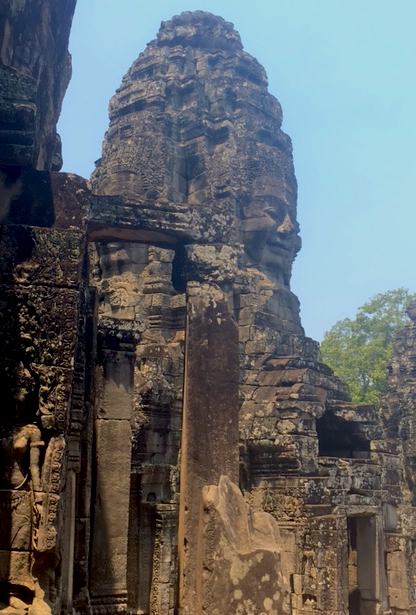
Bory dropped us off at the front of the Bayon temple, and we walked in with open-mouthed astonishment as we tried to take in the visual assault of ancient art and religion in this Buddhist temple with Hindu influences.  Huge carved faces of the bodhisattva are set in every direction, and the smiling profiles against weathered stone and the sky behind the steamy jungle gave us the feeling that we had entered the realm reserved only for hardy adventurers and well-funded archeologists, and we were thankful to be there.  After wandering the temple for a while through wisps of incense smoke, the girls sought a shady corner to rest, but Joseph and I went a little farther to explore the explore the exotic terraces of the elephants and the leper king and ventured out to the surrounding city wall to see the encroachment of giant jungle trees beside ornate gates splotched with lichen and stained with ancient trails of leached lime and salts from the heavy stone blocks.

Bayon Temple


Tomb Raider


We joined the girls in the shade and drank more water as the heat and humidity continued to rise along with the surging song of the insects in the jungle.  Bory suggested that we stop at two smaller temples that he liked as we gradually made our way to the final stop at the temple of Ta Prohm, and we enjoyed the elegant art and architecture contained at these two sites.  After a short visit, we checked out a roadside vendor and bought more water and a ring of miniature bananas that proved to be a sweet and sustaining mid-afternoon snack.


A lot of visitors to Angkor purchase multi-day passes and spend eight to ten hours at the sites each day sometimes traveling the distances between the temples on bicycles, and I don’t see how they pull it off in the intense heat of the jungle.  I suppose youth and the pursuit of a doctoral thesis provide enough energy and motivation for some, but by the time we reached the fabled temple of Ta Prohm, we were almost sapped.  Bory dropped us off at the path leading to the temple, and we walked a long distance through the jungle to both the sounds of booming drums being played by a pathside band and exotic birds deep in the thick forest.  The blockbuster movie Tomb Raider was filmed at Ta Prohm and it has since become the favorite temple among visitors because of its moss-covered ruins made more resplendent by crumbled walls strangled by the roots of trees as the jungle strives to claim the shrines for its own.  For some reason, the smart people with botany degrees can’t decide if the larger trees are silk-cotton or thitpok and if the smaller ones are strangler fig or gold apple—I wish I could be privy to those scintillating debates.


Upon entering the main gate of Ta Prohm, all feelings of weariness left us as we beheld the culmination of fantasy conjured from years of movie magic and actual human history, and we lost track of time as we wandered in and out of dark corridors full of toppled blocks carved with smiling gods and scrolls of intricate characters.  Shaded courtyards contained by stone walls buckled with the weight of huge roots and vines created scenes of intense wonder. I gave this temple the rare distinction as one of the coolest places I’ve ever been.  As awe-inspiring as these temples must have been during the time of the Angkor empire, seeing them in ruin, still full of artistic power covered with the weathered green patina of centuries spent in the deep jungle, was an event my little family will never forget.


Can you see me?


We climbed into the back of the tuk tuk and told Bory to head back to the Wheel Garden residence where we anticipated anticipating jumping into the pool to get relief from the heat of the day.  During the course of the ride home, I thought about all of the wonderful things we had seen that day in the jungles of northern Cambodia, and I was jazzed that I also managed to find some geocaches at the sites we visited—as close to actual treasure hunting/tomb raiding as this fifty-year-old painter from North Carolina will ever get.  But I’ll take it, oh yes, I’ll take it.


Bory dropped us off, and we thanked him for driving us around ancient Angkor, and we also worked out a deal for a ride to the airport at the end of the week.  The pool felt every bit as good as we had hoped, and we spent a couple of hours in and out of the water until we were driven back indoors by the sound of incessant chanting coming from a loudspeaker in the street out front which I had noticed the night before as well.  I asked the restaurant proprietor about the sound, and he replied, “Somebody die.  The family have a monk come and chant in front of house.”  I asked how long this sort of thing goes on.  “If the family poor, one day.  If the family rich, many, many days” was his direct response, and since I’m still hearing the chanting as I write three days after I first noticed it, that family must be loaded.  I wonder if the neighbors get together at some point and take up a collection to bribe the monk to stop.


We’re spending our last day in Siem Reap doing school lessons, writing, resting, and planning for our journey to Singapore which begins at 3:00 tomorrow afternoon.  Of the three countries in southeast Asia we’ve visited, our time in Cambodia has been the shortest, but the memories we’ve made here are intense with wild beauty and human history both tragic and glorious.  This part of the world is vastly different from anything we’ve ever known, and we’re leaving it with impressions of smiling stone silhouettes peeking out from ancient vines and the smiling faces of the people we’ve met who were glad we came to their country.