Sunday, February 12, 2017

Vietnam - Cat Ba Island


I’ve been a member of the Boy Scouts of America for many years, both as a youth and an adult, and I’ve practiced many water rescues and assisted with training many young people how to get someone out of the water properly.  Up until two days ago, I had never seen an actual rescue, but I witnessed a textbook water retrieval just off the shore of Cat Ba Island in Vietnam, of all places.  

We began our Friday with an early wakeup and Uber ride back to the old quarter of Hanoi to commence a half-day journey to Cat Ba Island, which involved a long bus ride, a ferry trip, and another bus.  Cat Ba Island is a popular destination in north Vietnam because of the beauty of Halong Bay. Many people book package tours from Hanoi which include transportation, hotel, and tours of the bay— at a cost of hundreds of dollars.  Deena cracked the Cat Ba code and booked all aspects of the trip into separate parts. Her additional research and follow-up allowed us to visit this spectacular World Heritage site for three days for about forty dollars a person—the meals are extra, but they cost only about a dollar each.


We sat on the stairs in front of the booking agency where we secured the first bus journey and waited for our ride as the businesses on either side were opening for the day around 7:30.  We must have looked pitiful and homeless because people kept walking up and giving us bottles of water and bags of fruit with concerned looks in their eyes—this may turn into another money-saving strategy during our time in Vietnam.  We sat waiting in the chilly morning air and watched as thousands of passing motor scooters carried parents and children, businessmen, and entrepreneurs with their wares strapped on two-meters high as they headed off to another day in Hanoi.  Inside the small cafe across the street, people sat close together around low plastic tables and attacked big bowls of noodles with chopsticks as they prepared to face the day.  Our bus showed up right on time, and we crammed our luggage into the hold, found seats, and sat back for the three-hour ride east out to the coast.


Once we left the busy streets of Hanoi, the land became green and pastoral with farms dedicated to rice fields, and banana trees lined the highway for the entire trip.  The rice was still young and grew just above the level of the water in the paddies while workers in conical straw hats squatted to their tasks in scenes from a living postcard.  As we drew near the coast, the bus entered a restricted area patrolled by guards, and we drove for many kilometers through an area designated for industry and cargo transport judging by the huge factories belching thick fumes from smokestacks behind multicolored shipping containers stacked in long rows like giant legos.  The driver stopped on a dirt road bordering a canal, and we could see numerous wooden piers with canopies along the waterway with several ferry boats in the distance making their way toward our group with air horns blowing.  The no-nonsense crew stowed our gear, helped us aboard, and we were off into the bay as the small craft weaved around hulking tankers and massive cargo ships sending waves of brown water slapping against their rusty hulls.


Our boat was nearing the dock after a thirty-minute ride, and all the passengers looked starboard to see a young man in the middle of the harbor bobbing up and down in the murky water.  His wet black hair was stuck to his face as he crested the waves, and he was struggling to stay afloat.  Our captain spotted him, wheeled the boat around, and leaped from his seat grabbing a life preserver as he ran to the rail, and tossed it right in front of the young man, who made a desperate grab for it.  One of the mates steered the boat closer, and the captain took a coil of rope and tossed a line to the young man and pulled him in, hauled him up, and set him down exhausted on the deck.  He was questioned in rapid fire Vietnamese as the ferry passengers speculated on his situation.  There were a few other ferry boats in the near distance. Did he fall off?  Was he tossed overboard for trying to cop a free ride?  We’ll never know the answer, and the young man slipped away as soon as we docked at the small ferry harbor on Cat Ba Island.  We stowed our luggage on yet another bus, found seats, and the successful rescue efforts of our astute ferry captain were soon forgotten as we drove into Jurassic Park.


The terrain of Cat Ba Island is incredibly beautiful with slender, rounded-top mountains sweeping up from the jungle valleys along with tall monodocks, their sheer rocky sides capped with green covers of thick foliage.  There were leftover morning mists still swirling around the mountains as we made our way along the narrow twisting road that eventually led into Cat Ba Town, built in a semi-circle around a natural harbor fortified by a thick seawall.  The bus dropped us off at the center of the township, and we had about a ten-minute walk to our hotel on the far side of the harbor.  We had fun checking out the cafes and shops as we strolled along and picked out possible spots for meals later in the day.  Our hotel was tall and narrow, three rooms deep and seven stories high with the front rooms looking out over the harbor.  We were fortunate enough to be assigned to a harbor-view room on the seventh floor, and our brightly colored chamber sporting a gray tiled floor and windows framed by gold curtains cost us a whopping twelve bucks a night.


We settled in quickly and had success finding a small cafe run by a friendly young family, who served us steaming plates of fried noodles with crispy vegetables and tender slices of chicken.  I finally had the opportunity to try real Vietnamese drip coffee prepared in yet another way humans have devised to brew this excellent beverage.  The server brings a clear glass cup sitting in a bowl of hot water with a small metal pot that resembles a creamer cup perched on top of the glass.  The metal pot contains finely ground coffee and boiling water, and the coffee drips slowly from a filter in the bottom of the pot into the glass.  It’s a lengthy process, and the hot water in the bowl keeps the coffee hot until it’s ready to drink.  The resulting coffee is an intense, aromatic brew that could best be described as an elixir that leaves a thick amber residue on the sides of the glass when it’s tipped and would have one’s teeth looking like yellow corn after drinking it for a few weeks.  The world looks different after consuming a cup of this stuff, and I loved it and considered swimming across the bay or running through the jungle up a nearby mountain, but once the travel weariness took over, I settled on walking back to the hotel for a nap instead.


The hotel owner arranged our trip out to Halong Bay, and the next morning our driver showed up promptly at 8:00 to take us to the harbor, which was only about a fifteen-minute drive.  We met our captain and crew and boarded the junk with two men from Poland and a young couple from Maine.  The air was cool and the sky was cloudy, but the sun was starting to break through occasionally, and there was a soft breeze coming off the water as we set sail.  It was too chilly to sit on deck, so for the first part of the tour we sat in the front cabin on foam beds looking out the windows.  The walls of the cabin were made of three-inch tongue-and-groove boards, which were cherry red and shiny from years of sanding and the oft-repeated application of thick glossy varnish.  Halong Bay is famous for its emerald green water and thousands of limestone islets called karsts, which are topped with thick rainforest verdure.  The bases of the karsts have eroded away by time and tides over the millennia, and the result produces an illusion that makes it appear as if the islets are floating on the surface of the deep green water.  There is no place like Halong Bay in the world, and we were fascinated with the views as the boat took us deeper into the basin cruising past floating villages populated by fishermen and their families.


We sailed for two hours until the boat reached an inlet surrounded by towering karsts, and we were joined by two other boats that tethered together with our craft.  We all boarded kayaks and spent an hour exploring the calm waters and picturesque rock formations, and we enjoyed it tremendously considering the majority of our kayaking excursions over the years have resulted in unmitigated disaster such as requiring rescue from the strong current of the Puget Sound and cowering in a mangrove swamp seeking shelter from an epic south Florida thunderstorm.  


We returned to the upper deck of the boat and shared an excellent luncheon with our fellow passengers and told travel stories as we devoured plates of fish, rice, and vegetables prepared by the multi-talented crew.  We cruised for a couple of more hours after lunch and stopped at Monkey Island for a challenging hike to the top of a mountain where we enjoyed the view before descending back to the beach to see the resident macaque monkeys scamper around.  These critters put on quite a display for the tourists. Joseph decided to get some up-close footage of these playful primates, so he crouched down next to one and focused his camera.  His subject was picking up sand and dropping it, so Joseph decided to pick up some sand and toss it to the monkey which resulted in the little beast baring its teeth and charging my surprised son.  The rest of the monkey tribe joined in and chased Joseph down the beach while his mother prepared to step in and defend her son with a water bottle.  Fortunately, the creatures gave up before their visages were altered by a 1.5 liter Aquafina-packing mama, and we made it back tour our boat unharmed with some great pictures.  


Mountaintop

Hiking up

Before the charge


We were close to the harbor, so we bid our fellow passengers farewell as they prepared to spend the night on the boat, but we boarded a water taxi for transport to the dock and the driver that was waiting to take us back to our hotel.  It was a fun, full day of beautiful scenery, new friends, and adventure that left us exhausted.  Deena and I enjoyed a dinner date in town since the kids elected to stay in the room and rest, and we shared a nice evening together in a quiet cafe.  We talked about the amazing day we had, and got a bit melancholy as we discussed how one day these grand adventures will end, but we’re thankful for the opportunity to see all these wonderful things together with our kids.


We slept a bit later the next day and enjoyed breakfast prepared by our hotel owner’s wife and had great fun playing with their kids as they mooched all the watermelon from our plates.  We sent our laundry out to be done for about $1.50, and we’re planning to spend the day completing some school assignments and relaxing in town along the seawall as we watch the boats in the harbor with their red and yellow Vietnamese flags snapping in the ocean breeze.  I’m sure that coffee and naps will place prominently in our itinerary as well.  Tomorrow we pack up again and head south to the village of Ninh Binh and get a little deeper into the jungles and mountains of Vietnam as we get to know this compelling country and its friendly people a little more each day.


Hotel owner's kids


Thursday, February 9, 2017

Vietnam - Hanoi


In February of 1966, I was four months away from birth, and a lot of young men in the United States were hoping to stay out of Vietnam.  Fast forward fifty years, and I was standing in the airport in Bangkok with my family holding up the boarding line worried that I wouldn’t get into Vietnam.  We were bound for Hanoi, the capital city of a reunited Vietnam and home to seven million people in the metropolitan area, and the airport employees were concerned about the status of our visas.  

In the late 1970’s, my home state of North Carolina received a large number of Vietnamese refugees known back then as “boat people” because of their method of escape from Vietnam.  Most were political refugees who were forced out of the country in the turmoil following the fall of Saigon after the United States military evacuated and the North Vietnamese prevailed.  I knew very little about the complicated Vietnam War back then, but I was curious about the sudden appearance of Asian people in my school speaking a strange language looking completely bewildered.  


A few years later, I was a junior in high school sitting in an Algebra II class hopelessly, miserably lost as the numbers and equations swam on the page in front of me, and I wanted so badly to be anywhere but there.  I cowered in my chair hoping to be as inconspicuous as possible so the teacher wouldn’t notice me and call me to the board to work a problem that I had no idea how to solve.  Looking back now, I realize that he knew my ineptitude and called me up to the board more than anyone else in the class to use me as some sort of example.  I don’t know where that dude is now, but I hope he has a case of world-class toenail fungus.  I didn’t have any friends in the class, and I shared my corner of despair with two Vietnamese guys who spoke no English but were capable of solving algebraic equations with lightning speed and probably should have been placed in higher level classes where all the cool, college-bound kids were hanging out.  


They sized me up pretty quickly and then made it their mission to help me understand the intricacies of the equations and alleviate my suffering.  I was ashamed of my failure and too embarrassed to ask anyone else for help, but I readily accepted their honest compassion even though I was a lost mathematical cause.  Those two young men with quick smiles and warmth in their eyes have come to my mind many times over the years, and I hope they went on to have rich lives full of blessings.  Getting to know them piqued my curiosity about Vietnam even more, and I wondered about life in this mysterious country forever linked to the United States in uncertainty, misery, and hope.


The AirAsia employees in the Bangkok airport let Deveny and me pass the gate and board the bus on the tarmac, and when I looked back, I could see Deena and Joseph in the other line in a state of consternation as they were being heatedly questioned.  Eventually another employee ran out to the bus and removed my daughter and me, and we all stood at the desk pulling out documents as the passengers behind us rolled their travel weary eyes.  We had applied for and received letters of invitation from the Vietnamese Department of Immigration, filled out visa applications, and had extra passport photos taken all in preparation for the visa-on-arrival process at the Hanoi airport—about the only way to properly enter Vietnam without lengthy embassy visits.  For some reason, the Thai airline officials were hesitant to allow us to leave their soil, but after inspecting each page of our documents, they finally allowed us on the bus to board the plane on the tarmac.


The flight to Hanoi was our second leg of air travel that day, and we were weary and anxious about the visa process upon landing, but we still maintained mostly positive attitudes as we crossed over into the Socialist Republic of Vietnam.  Our fears were unwarranted as the officials at the airport in Hanoi were efficient and friendly, and our documents were accepted as correct and complete. After about an hour of waiting with a throng of visa hopefuls from all over the world, we finally had our colorful Vietnam visas firmly affixed in our passports.  Our host, Son, met us at our apartment after a forty-five minute taxi ride. After a brief tour of the space and a quick question-and-answer session about the neighborhood, he left us to fall into bed at midnight.  One of the most difficult aspects of our trip has been relocating to a new area after finally getting the hang of the last one and going to bed after a long travel day knowing there’s no food in the house and having no firm plan about acquiring some.  We’ve had to start completely over thirty-two times so far, mostly in places where English is not the primary language, and while the process can be a burden, the payoff has been worth it.


On our first morning in Hanoi, Deena and I let the kids sleep while we walked down the street in search of a grocery store, and we found a good one about three blocks away.  We enjoyed shopping for breakfast items and a few basic staples. After a brief struggle to understand the currency, we walked home carrying 250,000 Vietnamese Dong worth of supplies equivalent to about twelve US dollars.  We had a nice, slow morning while cooking breakfast and enjoying the views of Hanoi from our eighth-floor balcony and eventually felt rested enough to venture out into the city.  We snagged an Uber in about thirty seconds and made our way to the old quarter of the city and the famous Thang Long Water Puppet Theater, where we bought tickets for the 4:00 show and were quickly seated in the last row.  


Water puppetry in Vietnam dates back to the eleventh century, and these days it’s performed in small venues with a house band providing accompaniment for the richly decorated and lacquered puppets that dance on top of waist-deep water under a red pagoda.   The figures are controlled by puppeteers using long bamboo rods, and the whole thing was one of the freakiest spectacles I’ve ever witnessed.  Fire breathing dragons, villagers chasing fish, and battling serpents were just a few of the scenes played out to music layered with percussion and warbling strings that made the hour-long presentation seem like a colorful Asian dream.  At the end of the show, no less than fifteen puppeteers emerged from behind their screens to vigorous applause, and we left the theater feeling like we had viewed something special.


We had booked a 6:00 tour with Hanoi Kids and filled the hour in between walking around the historic lake nearby and enjoyed the displays of flowers and red-lacquered pagodas.  Our tour was to be focused on the inexpensive and amazing street food available everywhere in Vietnam, but I wanted a quick education so as not to eat an eel or weird mushroom by mistake.  The Hanoi Kids organization is made up of college-aged young people who give all kinds of tours for free in order to improve their English skills and promote Vietnamese goodwill to visitors.  We were met by Bach and Em, a young man and woman eighteen years of age and mature and enthusiastic in their demeanor.  We agreed on the foods we wanted to try, and then we set off to tackle the wild and intimidating streets of Hanoi.  


On one of our trips to Florida years ago, we stopped at the University of Florida to walk around the school for a bit, and I was amazed by the presence of hundreds of multicolored scooters and motorbikes piloted by students as they made their way around campus.  In Hanoi, there are hundreds of thousands of these motorbikes weaving in and out of traffic in a constant stream of forward motion, and it takes the skills of a Jedi to cross the street.  Before we met Bach and Em, we stood on the side of the road waiting for a break in traffic that never came while elderly people didn’t even bother looking before stepping off the curb and walking slowly and steadily to the other side, never once looking at oncoming vehicles.  Bach and Em began to teach us this skill as we walked to our restaurant and enjoyed looking at the French colonial buildings painted bright yellow with jungle green shutters. Most of the buildings were surrounded by huge ficus trees growing out of the undulating sidewalks.  The French left Vietnam in 1954, but their influence is still very visible in the form of architecture and the love of cafes that serve good food and superb coffee—my kind of place.


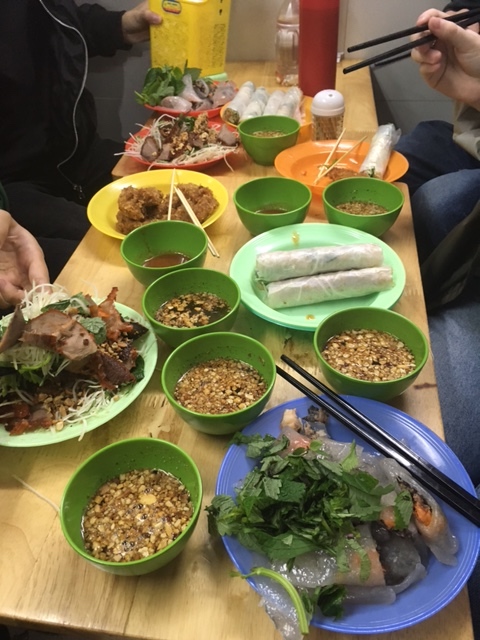
We stopped at a popular restaurant where the chef was stationed by the side of the road at his multi-faceted station with small tables and chairs in an open-air space behind him.  Bach and Em ordered sliced beef salad with noodles, crispy fermented pork, glass noodle dumplings filled with chicken and chopped vegetables, and plates of spring rolls stuffed with cabbage, shrimp, and spring onions served with a fiery chili sauce.  We could not stop praising the freshness of the food and its rich, compelling taste. When we finally stopped eating, there were only three spring rolls left to take home. Our two young guides tried to find a place where we could sample Pho, the traditional Vietnamese dish of beef, noodles, and herbs, but all of the restaurants were packed, and we settled on some dessert drinks.  Bach and Em took us to Cong Caphe, a wildly popular coffee chain started by a teenager and sporting a Viet Cong theme complete with a 1960’s military motif. A specialty was coconut coffee, one of the most flavorful and sumptuous beverages I’ve had the pleasure of consuming.


We sat around a table outside for over an hour and talked with these two delightful young people about Vietnamese and American politics, economics, and social trends.  We were amazed at their knowledge of American history, and they were very candid when speaking about the communist government in Vietnam, the French occupation, and the war with the United States.  They said that some members of the older generation have “flashbacks” concerning the war and bouts of anger, but for the most part, the citizens of a unified Vietnam have placed all feelings of animosity in the past and and have goodwill toward Americans.  We thanked our young hosts for a wonderful evening and bid them farewell as we used our new Jedi warrior skills to navigate the streets and head into the eccentric nightscape of Hanoi.


Hanoi Kids


Next day, Deena and I decided to further the kids’ education by taking them to prison; so after a leisurely morning and late lunch, we summoned an Uber and made our way back to the old town and the infamous Hoa Lo Prison, also known as the Hanoi Hilton.  The majority of the prison was demolished by the communists, but the main entrance is still there along with the guard house and a long wing of the original building which has been converted to a museum.  Hoa Lo sits in the middle of a busy residential district and if not for the six-meter-high walls capped with broken glass embedded in concrete, most passers-by would disregard the structure as ordinary and remain unaware of the past horrors that took place within its confines.  The prison was built by the French in the late 19th century for the purpose of restraining local malcontents and political upstarts whose voices of dissent against the foreign government grew louder as the years progressed.  In the early 20th century, Hoa Lo was full of future communist party leaders, and many were successful in escaping through tight sewers packed with waste and roaches.  Many others were sent to the guillotine for their political efforts, and one of the two original machines of death is on display outside a cell block.

Hoa Lo Prison - Hanoi Hilton

After the French were defeated and left the country, Hoa Lo was used as a center for government activity and political indoctrination. When the Vietnam War heated up in the 1960’s, it once again became a prison in which POWs were held including American pilots John McCain and James Stockdale.  A whole wing of the Hanoi Hilton is dedicated to the American pilots, and the flight suit that McCain was wearing when he was shot down and arrested is on display along with many pictures of the men smiling and having a grand old time in confinement.  The placards describe the respectful treatment bestowed upon the Americans despite their crimes, and many examples are given showing how the men led fun, fulfilling lives together until the end of the war.  

Hanoi Hilton

Embedded glass


The Vietnam War has been a major interest of mine over the years, and I’ve read countless books, watched numerous documentaries, and talked to many veterans that strongly and completely contradict the Vietnamese presentation in the Hanoi Hilton museum, but I guess with victory comes the right to spin the story from the homeland perspective, but it’s difficult to swallow.  One of the most chilling films clips from the war is from a propaganda interview of Commander Jeremiah Denton by his North Vietnamese captors.  Under the guise of having difficulty with the bright lights on the set, Denton used Morse code to blink out a harrowing one-word message while talking about the adequate conditions in captivity—torture.  That’s all I have to say about that.


After leaving the historical but depressing ocher walls of the Hanoi Hilton, we needed a coconut coffee boost, so we pulled up Google Maps for the closest Cong Caphe and found one a short distance away.  Our brief walk turned out to be serendipitous as this shop was located on the corner of the square surrounding the Saint Joseph’s Cathedral, also known as the Notre Dame of Hanoi.  The cathedral was one of the first structures built by the French in the late 1880’s, and today it serves as a place of worship for the large Catholic community in Hanoi.  We walked inside and sat quietly for a while on the mahogany pews and listened to a few hymns played through speakers around the altar before scoring a good table at the Cong Caphe and ordering an array of iced treats.  We enjoyed looking out to the vibrant square full of young people strolling and motorbikes whizzing by.  Old burly trees with thick green canopies stood in front of lime-washed French-style buildings creating a rich scene unlike any I’ve witnessed so far on our trip, and I contemplated how the passage of time, forgiveness, and healing allowed my little family to be a part of it on a sunny afternoon in February.


Cong Caphe

Notre Dame of Hanoi


We secured another Uber to take us home, but after a time of rest, we ventured back out to the streets where we located a vendor serving large portions of Pho. We ordered meals and sat around a low plastic table near the road.  Our bowls arrived a few minutes later full of steaming broth and packed with thick rice noodles, sliced beef, and an array of fresh herbs and spices.  It was delicious, and we savored every spoonful while we talked about the unforgettable things we saw in this multi-layered capital city.  We have one more full day here before heading south, and we’re hoping to explore the area around our neighborhood a bit more.

Pho real

Deena and I left the kids snoozing in the apartment the next morning while we walked down the street and secured a two-dollar sackful of omelet sandwiches for breakfast and some strong chocolate coffee to wash them down.  A cold front passed through north Vietnam during the night, and there was a leftover stiff breeze swirling through the streets with temperatures in the low sixties.  Deena wore a light jacket while I was sporting only a t-shirt, which provoked numerous stares from the locals who were bundled up in their down coats.  We spent the rest of the morning and most of the afternoon on school work and began to develop a plan for finishing the curriculum by the end of our trip, and by 3:00, we were ready to get back outside.  There is a large park with a lake just around the block from our apartment which proved to be the perfect remedy for cabin fever, and we spent a couple of hours walking several kilometers around this pretty place, which was popular with dog owners, fitness buffs, and fishermen.  


We were glad to get another perspective on our neighborhood, and we’re altogether pleased with our time in this busy capital city.  We have one more round of street food scheduled on the itinerary tonight; then it’s time to start packing for an early, four-hour bus trip to Halong Bay and the scenic wonders of Cat Ba Island, our home for the next three days.  A few nights ago, Bach and Em, our two young tour guides, asked us if Hanoi was anything like we had imagined, and we answered, “No, it’s been way more incredible than we expected” much to their tremendous pleasure.


Wednesday, February 8, 2017

January Budget Report and Credit Card Tips

Hello everyone, Deena here, and I’m happy to report that we had a good January with our average daily spend of $114—not quite as low as I would have liked, but there it is nonetheless.  We had our most expensive day of the trip in early January, our day in Petra, and it skewed our numbers a bit for the month.  Most of our month was spent in Thailand, which is considerably less expensive than countries we've visited previously.  We loved the food and culture of Thailand and can’t wait to get back soon.  We spent three weeks in the central and northern part of the country, and we'll return in April to see the southern part of Thailand, particularly the beaches.


Currently we are in Vietnam as part of a three-month stay in Southeast Asia.  Our hope is that the lower cost of living in these countries will help us gain some ground in the budget in preparation for the more expensive countries of Australia and New Zealand coming toward the end of the trip.  Lest you think we have it all figured out down to the last dollar, I have to confess that I accidentally spent twelve bucks on a quart of Haagen Dazs tonight.  I’ve been fuming about it all evening, so not a good night to write about the budget, but the ice cream was pretty good.


I have shared earlier that we have been able to fly free for most of our trip due to credit card signup bonuses achieved by meeting what’s called a minimum spend.  This term refers to an amount of money, typically three-to-five thousand dollars, that must be spent on the card over a three month period.   Some of you may look at the offers and think that the minimum spend is tough to reach without going out and running up a large balance on a card on unnecessary items just to get the points bonus.  This is not the case as there are many daily and monthly expenses that can be paid for with a credit card.  Mortgages, utilities, taxes, tuition, even a tithe to the church can all be put on a card.  We were able to pay our mortgage through ChargeSmart, which charges a small fee for the service.  I would not recommend doing it every month as it would get too expensive, but if  you are trying to meet a minimum spend that nets you several thousands in sign-up bonuses, it can be a good deal.  Some cards offer double and more points for gasoline, office supplies, and cell phone bills.  There are many ways to reach minimum spends without going out and buying more than you can afford.  It is also imperative that you pay off the card every month to avoid interest charges that would be counterproductive to earning a free flight.  Annual fees can be avoided by cancelling the card before the year is up as long as you have redeemed the miles.


Tune in next month to see how we did in Vietnam.

Saturday, February 4, 2017

Thailand - Mekong Cats, Long Necks, and a Sticky Waterfall


Last night we enjoyed a final supper at our favorite village restaurant and said goodbye to the very nice man who owns it as our time in the Chiang Mai area of Thailand draws to a close.  The first time we went there two weeks ago, we brought our own bottled water and looked around nervously for health-code violations as we swatted mosquitoes and waited for our dinner, which turned out to be delicious.  We’ve since been back many times, and the proprietor and his young daughter know our order:  two beef and rice with egg and two pork with noodles in broth.  We serve ourselves water in tin cups filling them with ice from an old, dingy cooler and water from pink plastic pitchers.  The owner/chef turns on the big overhead fans to keep the mosquitos at bay, and we enjoy a relaxing meal talking to each other and eating this amazing local cuisine, and we’ve grown bold enough to sprinkle our food with the finely ground peppers that give the food just the right amount of heat.  We’ll miss this place.


Most of the business owners in the village have a small apartment beside the space set aside for commerce, and both areas are covered by roll-up metal doors at night.  The meat and produce market stretches an entire block from the crossroads, and there’s a small Tesco Lotus grocery store across the street where we’ve bought most of our supplies for the past two weeks.  7-Eleven stores are everywhere in Thailand. This village has one just down the street from the grocery store, and it’s a popular gathering spot for the young people in the neighborhood.  My favorite coffee vendor practices his trade on the curb next to a long line of scooters and songthaew pickup trucks, and I’m gonna miss this guy too.  The Ban Pa Lan school is on the corner of our street just down from the village crossroads, and we’ve enjoyed watching the children play soccer in the courtyard while kicking up a cloud of dust. Their uniforms are similar to the white shirts and khakis our children wore in elementary school.  


Every morning there is a competition between several camps of roosters around our villa compound to claim the title of Loudest, Proudest Birds in Chiang Mai, and the other species of warbling birds in the field outside our wall give the roosters a run for their money.  The 6:30 am cacophony was disconcerting the first couple of mornings we were here, but now I’m used to it, and I know I’ll miss the sounds of the birds once we’re gone, but I’m sure there’s a rooster or two in Vietnam.  Our routine here has been slow and easy with late breakfasts, midday school sessions, afternoon coffee, and Thai cooking practice, and we’ve continued our study of basic economics in the evenings while adding an analysis of the differences in the major world religions.  We’ve also managed to sprinkle in a few other activities to fight cabin fever, and one of our favorites was the pursuit of the wild and wily Mekong Cat.


The Bosang Fishing Pond is located about thirty minutes from our house, and we secured an Uber to take us there on a hot afternoon a couple of days ago.  The pond spans several acres and is surrounded by coconut palms and thick forest beyond the edges.  A two-story building with bright blue clapboard siding sits at the entrance to the pond, and there’s a small cafe inside with a bar and a cashier stand where we rented a pole, bait, and help from a guide for the afternoon.  Our guide’s name was Chang, and he performed his duties shirtless with a big smile on his face and a plastic cup full of Leo beer on ice.  The bait was old bread and chocolate doughnuts mashed up and applied to the rig in a manner that would stay secure during a long cast into the pond.  Chang showed us how to adjust the drag when we got a strike and set the hook in a violent, arcing motion with the rod.  We shared a shelter along the bank with a young man from Tennessee, a retired cherry farmer from Washington, and a couple from Australia on holiday with their elementary-age daughter, who looked like she wanted to be anywhere but the Bosang Fishing Pond.


As the sun dipped down lower in the afternoon, the fish started biting, and we hauled in Mekong catfish the size of German shepherds, and believe me, they did not give up easily.  The thrill of catching these monsters was addictive, and we all got in on the action as we ducked and dodged the other fisherman on the bank as our prey dragged us left and right.  It was exhausting work, but the prospect of catching “just one more” kept us fishing intensely along with the guy from Washington, who was on his fourth day in a row at the pond.  He was wearing a wedding ring, but I didn’t inquire about his wife who I assumed must be at the spa back in the hotel while her fish-crazed husband stalked the Bosang banks.  Closing time came much too quickly, and Chang collected the bait and rods, and I gave him a nice tip so he could buy more Leo beer to help him perform this dream occupation.  We sat in the cafe and ordered a cheap dinner of spicy chicken and noodles with vegetables and told fish stories until our driver showed up to take us away from the place where all of our wildest fish dreams came true.


Chiang Mai is surrounded by jungle-covered mountain ranges, and we hired a driver to take us high in the hills one day so we could take in another perspective of Thailand.  Our driver was Mr. Nut, a great guy who kept us engaged all day with his stories about life outside the big cities.  We drove into the Lanna region, also aptly named the land of a million rice fields, and headed for the mountains on roads bordered by rice paddies and thousands of acres planted with sugar cane, corn, and tobacco.  There are many areas with hot springs bubbling to the surface outside Chiang Mai, and we stopped for a while at one of these places where the springs are harnessed by large tanks and piped through a network of decorative concrete channels.  We joined in with the other visitors and soaked our feet in the hot water and attempted to cook some eggs near the source of the spring where the water is close to boiling temperature.  Properly relaxed, we boarded the van and began the ascent to the village of Mae Kampong nestled in the green alcoves of the mountains at 1300 meters.

Boiling eggs in the hot spring


The jungle canopy became intensely thick and green the higher we drove, and the twisting road was flanked by huge banana and teak trees draped with vines the size of fire hoses.  The cool, mountain slopes of northern Thailand are well suited for growing world-class coffee beans, and we could see thick stands of coffee plants stretching back into the jungle with thin rays of sunlight barely touching their jagged, deep green leaves.  Many of the small farms along the mountain road dry and roast their product, and we saw long, low troughs full of cream-colored coffee beans drying in the sun. I had seen this process previously only in documentaries.  We arrived in Mae Kampong around lunchtime, and Mr. Nut took us to his favorite restaurant, where we enjoyed fried chicken and spicy sausage with sticky rice while listening to a stream rush by the window next to our table.  The air at this altitude was cool and dry and perfect for hiking, and after lunch, we enjoyed a stroll through the jungle to a waterfall beside a small Buddhist temple set back in the thick vegetation.  Most of the homes and businesses in the small village are built into the rocky terrain beside the streams and waterfalls giving the mountain hamlet the look of a large, rambling tree house constructed by elves.  


After hiking and exploring for a while, Mr. Nut took us to his favorite place in the village for coffee, which had a food and beverage station near the road and multiple seating areas built onto the boulders lining the stream and connected by thick-planked walkways.  Deena and the kids enjoyed some baked goods while Mr. Nut and I eagerly watched the barista patiently prepare our americano beverages.  She took some black, oily beans provided by one of the local farms and finely ground them filling the air with an intense nutty aroma. She then packed the grounds into an espresso machine, which yielded a strong thick brew topped with rich crema.  She added hot water to the espresso and served us the coffee in clear glass cups, which we took back to our table beside the stream.  The coffee was strong, smooth, and aromatic with sweet floral hints, and it was some of the best I’ve had on our trip.  At some point, I’ll compile a list of my favorite cups of coffee around the world and rank them accordingly—the Mae Kampong cup will place highly.

Nice spot for coffee

After a full afternoon in the cool mountains, we descended to the valley floor and headed to our village, trying to fight sleep so we wouldn’t miss any of the views along the way, but Joseph and Deveny finally zonked out in the back of the van.  Mr Nut wanted to show Deena and me a rice paddy up close, so he found a place to pull over on a road bordering a huge farm, and we ventured out along the rows.  “Be careful,” advised Mr. Nut as he pointed to a muddy depression along one of the furrows, “hole for rat.” We stood beside him looking furtively over our shoulder for man-eating rodents as he explained the process for growing rice in large quantities, and we were amazed to learn that most of the work is still done by hand by laborers earning about ten dollars a day.  We purchased a watermelon from a lady operating a stand by the side of the road, and Mr. Nut delivered us safely home after this long fun day in the mountains.


We hired another driver to take us on a final excursion before leaving Chiang Mai, and this time, our destinations were the nearby village of the Karen Long Neck Tribe and the sticky waterfall about an hour north of the city.  The Karen Long Necks are indigenous to the hills of Myanmar, but most have relocated in Thailand to escape warfare and persecution in their homeland.  Deena and I remembered seeing the women of the tribe with their extended necks wrapped by brass coils gracing the cover of National Geographic magazine in the 1970’s, and this international exposure brought them notoriety back in the day.  We pulled up to the village, and our driver mentioned that there was a steep admission fee of which we were unaware and wiped me out of most of the cash in my pocket.  Once inside, our driver showed us the residential section of the village which consisted of about twenty-five poorly constructed tin-roofed shacks circled around a large privy.  There were bins between the shacks overflowing with trash, and little kids ran around the privy in bare feet while scrawny chickens pecked around the rubbish piles.  


The main path surrounding the residences were lined with booths packed with crafts supposedly made by the women of the tribe who dutifully sat among their wares beckoning the tourists to have a look.  Although all of the women we met were wearing coils around their necks, most were younger and didn’t have the extension exhibited by the two older ladies we encountered.  We were told that the coils honor the gods and offer protection from tigers who tend to sneak into villages and go for the jugular while the men of the tribe are off hunting or farming.  Deena noted that the coils don’t actually extend the neck but rather force the clavicles down giving the neck an extended appearance.  I bought Deveny a bracelet to justify taking a few pictures of the ladies, and as we left, we all agreed that it was more fun watching a chicken scratch the ground for her chicks in the jungle than gawking at the Long Necks in this strange and slightly sad setting, which we were told benefits the tribe through fees and goods purchased.  As I’ve looked through my American, manicured-lawn tinted glasses, I’ve been reminded over and over on this trip that most people choose to live the way they do and don’t need my pity.  With that thought in mind, Joseph and I felt good about supporting the tribe by paying to shoot wooden arrows into a target from an awesome crossbow that was surely used to take down monkeys and tigers in the jungles of Myanmar.


Lord have mercy on me, a tourist

We left the Karen Long Neck Tribe and headed north to the jungle and the location of one of many sticky waterfalls in the area which are hugely popular with Thais and tourists alike.  In my corner of North Carolina, stepping on a dark, algae-covered rock in the middle of a waterfall is the gateway to an instant plunge into an icy mountain stream.  In the Bua Tong area of northern Thailand, there are pristine waterfalls cascading down rocks covered by centuries of mineral deposits to which no algae will attach.  The result is a slightly spongy surface with incredible traction that allows an intrepid jungle explorer to scale the waterfalls feeling like spiderman.  Our driver took us to an area which thankfully had no admission fee and a large picnic area near the walkway down to the falls.  We spent all afternoon playing in the cool water feeling the absolute joy of climbing straight up the falls with no fear of sliding down and being carried away into the jungle beyond.  There was a jovial mix of people there including Thais, a group of guys from New Zealand, and some girls from the United States who recruited me to photograph them scaling the sticky rocks.  We were reluctant to leave this natural playground, but hunger forced us back to the breezy picnic area where we enjoyed peanut butter and jelly sammiches under tall trees with leaves the size of placemats.


The drive home went by quickly, and we tried our best to commit the sight of the Thai countryside to memory as since we won’t see it again on this trip.  Our plan is to return to Thailand in early April to explore the famous southern beaches, which have a completely different look from the valley that we’ve called home for the last two weeks.  The small village on the outskirts of Chiang Mai has been a place of welcome, discovery, and refreshment as we’ve come from lands of vastly different looks and attitudes such as Europe and the Middle East.  We’re heading off to worship at the Chiang Mai Community Church this afternoon followed by an evening of cleaning and packing as we prepare for a long day of travel to Hanoi, Vietnam, and another adventure together.